The Balance Beam Is a STEM Toy.. Here Is the Science That Proves It
The Balance Beam Is a STEM Toy... Here Is the Science That Proves It
By Nikki Benbenek, Co-Founder of Blueberry and Third
When most parents think about STEM toys, they picture coding kits, building blocks, or science experiment sets. What they do not picture is a wooden balance beam sitting on the floor of a playroom. But after building Blueberry and Third and spending years watching children engage with our modular Balance Beam, I can tell you with complete confidence: the balance beam is one of the most powerful STEM learning tools you can put in your child's hands — and the research absolutely backs it up.
Here is why, and why it should be at the front of your Montessori playroom design.

What STEM Actually Means for Toddlers
STEM — science, technology, engineering, and mathematics — does not begin in a classroom. It begins on the floor of your living room the moment a toddler starts figuring out how things connect, what happens when they move their body a certain way, and how to solve the problem in front of them. Research published by Frontiers in Education identifies spatial ability as a critical gateway to STEM learning, noting that children who develop strong spatial reasoning skills in early childhood consistently perform better in math, science, and engineering thinking as they grow. And the single best way to build spatial ability in young children? Hands-on exploration and physical movement with real objects.
That is exactly what the Blueberry and Third Balance Beam delivers.

The STEM Case for a Modular Balance Beam
What makes our Balance Beam different from a standard kids balance beam is the modular design. Each beam connects to the next using simple joints that children can snap together and apart themselves — no tools, no adult required. This means that before a child ever takes a single step, they are already doing STEM.
They are engineering — deciding how the beams connect and in what order. They are applying spatial reasoning — visualizing what the course will look like before it exists and adjusting when reality does not match the plan. They are problem-solving — figuring out why two beams will not connect the way they expected and finding a solution. They are iterating — building one configuration, walking it, deciding to change it, and building again.
Research shows that children who develop strong spatial awareness skills also perform better in STEM subjects, and that spatial activities can enhance a child's foundational motor skills, which translates over to cognitive learning. The Balance Beam hits every single one of these developmental targets simultaneously, which is exactly why occupational therapists recommend it and why it belongs in every Montessori play area and kids playroom design. Blueberry and Third

The Cognitive Benefits of Balance Training for Ages 1 to 5
The STEM benefits do not stop with engineering and spatial reasoning. The act of balancing itself has profound cognitive effects on the developing brain.
The vestibular system — the sensory network in the inner ear responsible for balance, spatial orientation, and body awareness — is one of the earliest and most foundational sensory systems to develop. According to occupational therapists, most children today have underdeveloped vestibular sense, and this lack of development leads to easily being overstimulated, falls, aggression, and difficulties with attention. A balance beam in your playroom is one of the most accessible and natural ways to give children the daily vestibular input their developing brains need.
Balance training specifically improves spatial awareness — a documented predictor of STEM success. Mounting empirical evidence has suggested that spatial skills predict success in children's long-term development in the field of STEM, with researchers even regarding spatial skills as a STEM gateway. And experiments confirm that children perform better at spatial reasoning tasks when they are permitted to explore and handle objects. A modular balance beam that children physically assemble, reconfigure, and walk is object exploration at its most developmentally rich. Blueberry and Third

How to Design a Montessori Playroom Around Balance and STEM
If you are thinking about kids playroom design and ideas for a Montessori-inspired space, here is how to put balance and STEM at the center of your layout:
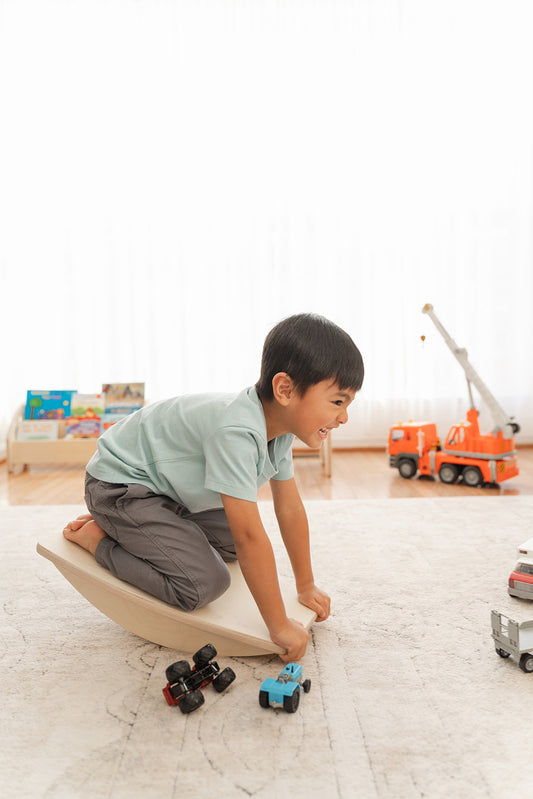
Start with the Balance Beam as your obstacle course foundation. Configure it in a simple straight line for toddlers just beginning to walk the beam, and let the configurations grow more complex as their confidence and skills develop. Add the Balance Board alongside it for a full movement circuit — children can rock on the board, then walk the beam, then reconfigure the whole course and start again. Include the Wobble Beam for children who are ready for a more dynamic balancing challenge that tilts side to side as they walk. Create a defined movement zone on a soft play mat or natural fiber rug so the space has intention and children know this is their engineering and movement area.
Leave the beams accessible and at child height so that even the youngest toddlers can initiate their own play, rearrange the course, and experience the full STEM loop of design, build, test, and redesign — completely independently.
This is what Montessori playroom furniture is supposed to do. Not just hold space on a shelf, but invite children in, challenge them, and let them lead their own learning. The Balance Beam does all of that in one beautiful, solid wood piece of modern children's furniture that was built in the USA, designed for real toddler life, and made to last well beyond the playroom years.
For other resources:
Kids Playroom Design and Why Balance Has Come First
How to Create a Montessori Movement Area At Home
What Age is Best For Balance Board
Best Wooden Toys for 2 Year Olds.. and Why The Balance Board Tops the List