How to Create a Montessori Movement Area at Home
How to Create a Montessori Movement Area at Home
By Nikki Benbenek, Co-Founder of Blueberry and Third
Montessori playroom ideas | indoor movement for toddlers | balance board for kids | climbing arch for babies | best playroom furniture ages 0–5
When I became a parent, I quickly realized that a playroom isn't just a room where you put toys. It's a child's first classroom. It's where they figure out gravity before they know the word. It's where they learn what their body can do, how far they can stretch, how high they can climb, and what happens when they wobble and catch themselves before falling.
That's exactly why we started Blueberry and Third. And it's exactly why I want to talk to you today about creating a Montessori-inspired movement area in your home, whether you're setting up a nursery from scratch, upgrading your playroom, or just trying to make your living space work for your little ones.
Because here's the truth: kids need to move. A lot. And they need to move indoors too.

Why Movement Is a Non-Negotiable in Early Childhood
We live busy lives. Some days it's 95 degrees outside and the backyard isn't an option. Other days it's below freezing and nobody's going outside for more than a few minutes. On those days, and there are a lot of them, the movement doesn't stop just because the weather says so.
Research consistently shows that physical movement in early childhood isn't just good for little bodies. It's essential for developing brains. Movement stimulates the vestibular system (the body's balance center, located in the inner ear), which is one of the first sensory systems to develop in utero and one of the most foundational for learning, attention, and emotional regulation.
When toddlers climb, balance, and navigate obstacles, they're not just "playing." They're building:
- Gross motor skills — the big movements that form the foundation for everything else
- Core strength and coordination — essential for sitting, writing, and focusing at school
- Spatial reasoning — a precursor to math and STEM thinking
- Proprioception — the body's internal sense of where it is in space
- Confidence and resilience — because every time a child catches their balance, they learn they can handle a challenge
The American Academy of Pediatrics (AAP) puts it plainly:
"Physical activity, including unstructured free play, is essential to the healthy development of children. Movement-rich environments support cognitive development, emotional regulation, and physical health in children from infancy through age five."
This isn't fringe thinking. It's the mainstream medical consensus. And in the Montessori world, it's been understood for over a century.

What Montessori Teachers Know About Movement and Learning
In Montessori philosophy, movement and intelligence are not separate. Dr. Maria Montessori herself wrote that "the hand is the instrument of the mind" — and she meant it literally. Children understand the world first through their bodies, and movement is the vehicle through which learning happens.
We've heard this echoed by Montessori educators across the country. One Montessori lead teacher put it this way:
"When a child climbs, balances, or navigates a physical challenge, they are not taking a break from learning — they ARE learning. Movement develops the neural pathways that support reading, mathematics, language, and self-regulation. A child who has had the opportunity to move freely and intentionally is a child who is ready to sit, focus, and engage."
This is why we believe so deeply in what we build. Every product we design at Blueberry and Third is intentional — made to support the kind of free, movement-rich play that Montessori and developmental science both champion.

Building Your Montessori Movement Area: The Essential Pieces
You don't need a huge space or a huge budget to create a movement area that genuinely supports your child's development. What you need are a few versatile, well-made pieces that grow with your child and invite open-ended movement.
Here's what we recommend — and why.
🌿 The Balance Board
Best for: Ages 2 years and up | Keywords: balance board for toddlers, wooden balance board kids, Montessori balance toy
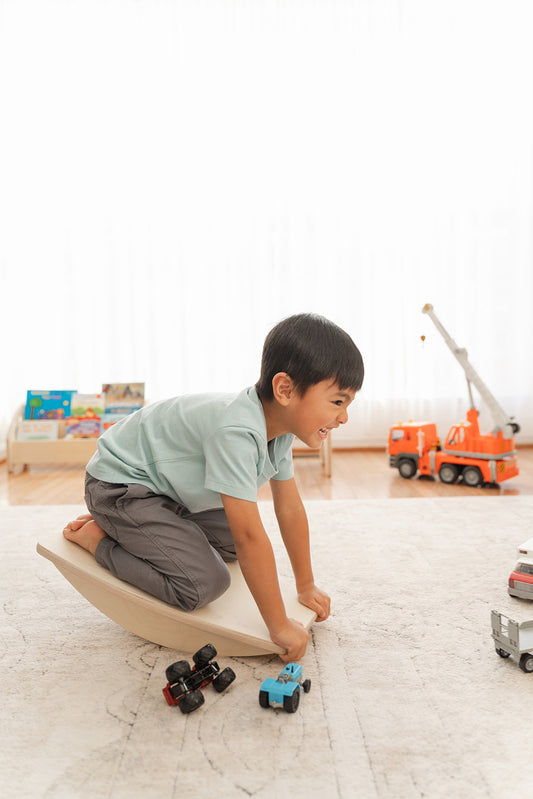
The balance board is one of the most deceptively simple, deeply powerful tools in a child's movement tool kit. It looks like a curved piece of wood. What it does is extraordinary.
When a child stands on a balance board, their body is constantly making micro-adjustments — engaging the core, activating the vestibular system, and building proprioceptive awareness. These are the same systems that help children sit still in a classroom, regulate their nervous system when they're overwhelmed, and develop the physical confidence to try new things.
Our balance board is made from solid hardwood at a workshop right here in Ohio. It's sanded smooth, finished with a non-toxic coating, and built to hold up to years — not months — of daily play. We designed it for children starting at around 2 years of age, and we've watched kids use it all the way through elementary school. Older children use it for yoga poses, push-up challenges, and skateboarding simulations. It is genuinely one of the best investments you can make in your playroom.

How children use it:
- Rocking side to side while standing (classic balance challenge)
- Sitting in it like a rocking boat
- Using it as a slide for small toys or cars
- Incorporating it into obstacle courses and imaginative play
How long will it last? Our balance board is built to last for generations. We've designed it to support children from toddlerhood through early elementary school — and it's sturdy enough to handle adult weight too, so parents can join in.
🌿 The Balance Beam
Best for: Ages 2–6 | Keywords: balance beam for kids, indoor balance beam toddler, Montessori gross motor toys, best playroom floor beam
Walking a balance beam sounds simple. For a two-year-old, it's an enormous cognitive and physical achievement.
The act of placing one foot in front of the other on a narrow surface requires full concentration, a child cannot walk a balance beam while distracted. It naturally invites focus. It naturally invites repetition. And every single time a child makes it to the end without stepping off, their brain releases a small hit of dopamine, the reward chemical that says "do that again."
Our balance beam sits low to the ground, making it safe for toddlers while still providing a genuine challenge. It connects to other pieces in our movement collection, making it easy to build obstacle courses right in your living room or playroom.

How children use it:
- Walking heel-to-toe for balance training
- Walking backwards (a significant developmental milestone)
- Carrying objects across the beam (builds bilateral coordination)
- Incorporating into imaginative play as a "bridge" or "tightrope"
- Connecting to the wobble beam and other pieces for full obstacle courses
How long will it last? Our balance beam is designed to grow with your child from their first wobbling steps around 18-months through confident, complex obstacle courses at age 5 and beyond. With standard use, it's a piece that will last the entirety of your child's early childhood — and hold its finish and shape the entire time.
🌿 The Wobble Beam
Best for: Ages 2–6 | Keywords: wobble beam toddler, indoor balance toy kids, sensory movement toy, best balance toys for toddlers
Think of the wobble beam as the balance beam's more challenging sibling. Where the balance beam is stable and flat, the wobble beam has a slight curve that introduces an element of unpredictability — the beam shifts slightly as a child walks, engaging deeper core muscles and requiring constant active adjustment.
For children who have mastered the balance beam, the wobble beam is a natural next step. For children who are just starting out, it can be used on the ground in a flat orientation. It's a piece that meets children exactly where they are.
The sensory feedback from the wobble beam is particularly valuable for children who are sensory seekers — kids who crave movement input, who tend to be "rough and tumble," and who need physical outlets for their energy. Rather than channeling that energy into the furniture, give it somewhere to go.

Building an Obstacle Course (STEM in Disguise)
Here's something I love to point out: when your child sets up an obstacle course using the balance beam, wobble beam, and balance board, they are doing STEM without knowing it.
They are:
- Designing a sequence (engineering thinking)
- Testing whether the design works (scientific method)
- Adjusting when it doesn't (iteration)
- Measuring with their bodies — can I fit here? Can I reach there? (spatial reasoning and early math)
Obstacle courses are one of the most cognitively rich activities a young child can engage in. And the best part? They can do it independently, in your living room, on a rainy Tuesday.
🌿 The Climbing Arch
Best for: Ages 9 months to 6+ years | Keywords: climbing arch for babies, Montessori climbing toy, first birthday gift baby, indoor climbing toy toddler, best gifts for 1 year old, wooden climbing arch
This is the piece I'm most excited to tell you about — and the one I recommend most frequently for parents of babies and young toddlers.
The climbing arch is the most versatile piece in our entire collection.
Starting at around nine months old, when babies begin pulling up to stand, the climbing arch gives them something safe, stable, and perfectly sized to pull up on. This is a critical developmental moment — pulling to stand is one of the most important gross motor milestones of the first year, and having a safe, purposeful structure to do it on makes a meaningful difference.
By twelve months, babies are cruising along the arch, building leg strength and balance for their first steps. This makes the climbing arch one of the best first birthday gifts you can give — it's not just a toy, it's a piece of developmental equipment that will be used every single day.

As your child grows, so does how they use the arch:
- 9–12 months: Pull to stand, cruise along the sides
- 12–18 months: Climb up and over the top (low, safe, achievable)
- 18 months–3 years: Full climbing, rolling toys down the slope, using it as a tunnel
- 3–5 years: Flipped upside down as a rocking boat, incorporated into obstacle courses, used as a fort base with a blanket draped over
The fort. Let's talk about the fort.
Flip the climbing arch upside down, drape a blanket over it, and you have an instant cozy fort that your toddler will disappear into for an entire afternoon. It becomes a reading nook, a hiding spot, a pirate ship, a cozy den. The same piece that builds gross motor skills at 10 months becomes the anchor of imaginative play at age 4. That versatility is exactly what we designed for.
Quality you can feel — and trust.
Our climbing arch is made from solid birch wood, sanded to a silky finish, and treated with non-toxic oil. It's built to support the weight of multiple children climbing simultaneously, and it arrives with a base that prevents tipping. Every joint is reinforced, every edge is rounded, and every finish is child-safe.
We designed this piece to last a minimum of 5–7 years of active use — from the moment your baby pulls up on it for the first time to the moment your kindergartner outgrows the need to climb indoors. That's an extraordinarily long lifespan for a piece of children's furniture, and it's intentional. We believe in building things that last.
The Playroom Upgrade Parents Are Actually Searching For
If you've been searching for:
- "best Montessori toys for toddlers"
- "playroom ideas for kids 0–5"
- "wooden climbing toys for toddlers"
- "indoor gross motor activities toddler"
- "best balance board for kids"
- "playroom furniture that grows with child"
- "what should be in a toddler playroom"
- "first birthday gift ideas that last"
- "Montessori indoor play equipment"
...then you've found what you're looking for.
Our movement collection — the balance board, balance beam, wobble beam, and climbing arch — is designed specifically for families who want their playroom to be more than a storage room for toys. It's for parents who understand that the best play is purposeful, and the best toys are ones that grow with their children rather than being outgrown in a season.
Made in the USA. Built to Last.
Every piece we make at Blueberry and Third is crafted in the United States — right now in a woodshop in Ohio — by American craftsmen who take real pride in what they build. When you pick up one of our pieces, you feel the difference immediately. The weight of solid wood. The smoothness of a properly finished surface. The solidity of joinery that won't wobble or squeak or fall apart.
We chose U.S. manufacturing deliberately, for three reasons:
Quality control. When our products are made close to home, we can see them, touch them, and hold our partners accountable to our standards in a way that simply isn't possible with overseas manufacturing.
Sustainability. A shorter supply chain means a smaller carbon footprint. We believe in making products that are good for children and good for the planet.
Longevity. Products made with quality materials and real craftsmanship last for years, not months. And a piece that lasts five years doesn't end up in a landfill after a single season.
We started this company in a basement with a simple belief: children deserve better than cheap plastic that breaks in six months. They deserve things built with intention, made with care, and designed to support who they're becoming.

Setting Up Your Montessori Movement Area: A Quick Guide
You don't need an entire room. A dedicated corner works beautifully. Here's how to set it up:
1. Clear the floor. Movement needs space. Remove anything that could get bumped into and create an open, low-distraction zone.
2. Use a natural fiber rug. A non-slip rug defines the space and softens landings. Natural materials like wool or cotton align with the Montessori aesthetic and are easy to clean.
3. Start with one or two pieces. For babies, start with the climbing arch. For toddlers, the balance board or balance beam. Add pieces as your child grows and shows interest.
4. Rotate, don't overwhelm. Keep two or three movement pieces available at a time. Rotating pieces keeps the space feeling fresh and inviting without overstimulation.
5. Let them lead. Resist the urge to demonstrate or instruct. Put the pieces out, step back, and let your child explore. You will be amazed at what they figure out on their own.

The Bottom Line
Creating a Montessori movement area at home is one of the highest-return investments you can make in your child's development — and in the functionality of your playroom. The right pieces don't just entertain. They build the body, develop the brain, and grow alongside your child for years.
Our balance board, balance beam, wobble beam, and climbing arch are designed to do exactly that.
Ready to start building? Browse our movement collection at blueberryandthird.com — and if you have questions about what's right for your child's age and stage, we're always here to help.
Because great play doesn't happen by accident. It's designed.

Have questions about our products or want help choosing the right pieces for your playroom? Reach out to us directly at hello@blueberryandthird.com — we love hearing from our community.
Related Reading:
- What Age is Best for a Balance Board?
- Why We Chose to Manufacture in the USA
- The Secret to Getting Multiple Kids in the Kitchen
Tags: Montessori playroom, balance board for toddlers, climbing arch baby, indoor movement toddler, balance beam kids, wobble beam, Montessori movement area, best playroom furniture, toddler playroom ideas, Montessori toys ages 0–5, wooden climbing toys, first birthday gift, gross motor development, made in USA children's furniture, Blueberry and Third