Kids Playroom Design and Ideas: Why Balance Has to Come First
Kids Playroom Design and Ideas: Why Balance Has to Come First
By Nikki Benbenek, Co-Founder of Blueberry and Third
When I started designing our playroom at home, I did what most millennial moms do — I went down a very long, very beautiful Pinterest rabbit hole. Neutral tones. Wooden toys. Open shelving. A calming corner with soft lighting and a little rug. And somewhere in the middle of all of it, I kept coming back to the same question: what actually belongs in a Montessori playroom that is going to serve my kids developmentally, not just look good on a grid?

The answer, after years of watching my own girls play and building a children's furniture company rooted in Montessori principles, is this: if you are setting up a Montessori-inspired playroom, balance items need to be at the absolute forefront of your design. Not as an afterthought. Not tucked in the corner. Front and center, accessible, and ready to use every single day.
Here is why — and how to do it beautifully.

The Science Behind Balance Play for Ages 1 to 5
Before we talk design, let us talk about what is actually happening in your child's brain and body when they engage with balance toys. The vestibular system is the sensory network located in the inner ear that controls balance, spatial orientation, and body awareness. It is one of the earliest sensory systems to develop, and it has a profound impact on everything from gross motor coordination to cognitive function, attention span, and emotional regulation.
According to research published in the Journal of Occupational Therapy, early vestibular stimulation during toddlerhood strengthens the neural pathways responsible for coordination, motor planning, and attention regulation later in childhood. A study by Ghent University on the involvement of the vestibular system in children's cognitive and motor development found that vestibular input plays a critical role in spatial reasoning, mathematical thinking, and even language development. And occupational therapists across the board recommend 15 to 20 minutes of vestibular play daily for toddlers — the kind of active, movement-based play that a balance board in the living room makes completely effortless.
Translation for the millennial parent in the trenches: when your toddler is rocking on their balance board, they are not just burning energy. They are building the brain architecture that supports focus, learning, and confidence for years to come. That is not a toy. That is an investment.

The Three Balance Items Every Montessori Playroom Needs
When I think about kids playroom design and ideas for a Montessori space, there are three balance items I come back to every single time. Together they create a natural children's obstacle course, support a full range of vestibular input, and give kids of all ages and ability levels something to work toward.
The Balance Board
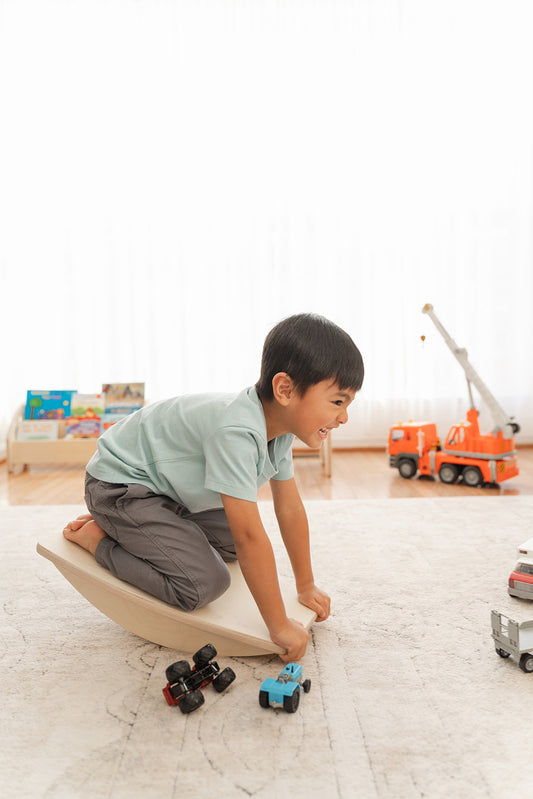
The wooden balance board is the foundation of any Montessori play area. It is the most versatile piece of toddler furniture you will ever own — a rocking tool, an imaginative play prop, a sensory regulation device, and an obstacle course element all in one. For children with ADHD or sensory processing needs, the rhythmic rocking of a balance board provides exactly the calming vestibular input that helps settle the nervous system and improve attention. For typically developing toddlers, it builds core strength, coordination, and the kind of physical confidence that carries directly into how they move through the world. Our Blueberry and Third wooden balance board is handcrafted in Ohio from sustainably sourced Baltic birch, ships fully assembled, and is one of the best gifts for a 3 year old boy or girl who loves to move. It is also one of the best non-toxic Montessori baby toys for children starting at age 2, because the vestibular benefits begin the moment little ones start engaging with the gentle rock of the board.
The Wobble Beam
If the balance board is the foundation, the Wobble Beam is the challenge. This tilting balance beam for kids rocks side to side as little ones walk across, requiring active balance adjustments with every step. It is perfect for activities for 4 year olds who are ready for more complex gross motor challenges, and it works beautifully alongside the balance board as part of a full Montessori obstacle course setup. The Wobble Beam builds the same vestibular and proprioceptive skills as the balance board but in a linear, directional way — training the kind of balance that shows up on playgrounds, in gymnastics, on bikes, and in sports. In a well-designed Montessori playroom, the Wobble Beam and Balance Board together create a movement circuit that keeps kids engaged, challenged, and developing in the best possible way.

A Dedicated Movement Zone
Here is the playroom design idea that changed everything for me: instead of scattering balance toys around the room, dedicate a specific movement zone where your balance board, wobble beam, and any other balance beams for kids live together. Use a soft play mat or natural fiber rug to define the space. Keep it open, accessible, and uncluttered. In Montessori design, the environment is the teacher — and a clearly defined movement zone tells your child that this is a space for active, intentional play. It becomes a natural calming corner for kids who need to regulate, a challenge zone for kids who are seeking physical input, and a creative play space for kids who are somewhere in between.
Designing for Real Life — Not Just for the Grid
I want to be honest with you, because that is how I built this brand: a beautiful Montessori playroom is not about having the most perfectly curated shelf or the most aesthetically pleasing layout. It is about creating a space where your child can actually develop, explore, and grow every single day. The best kids playroom furniture is the kind that serves a developmental purpose, holds up to real use, looks good in your home, and does not make you cringe when it is left out in the living room.
Our balance board, Wobble Beam, and the rest of the Blueberry and Third collection were designed with exactly that in mind — modern children's furniture built from solid, sustainably sourced wood, finished with non-toxic coatings, made in the USA, and designed to be as beautiful as it is functional. Because your home deserves both, and so do your kids.
Start with the balance board. Build from there. And watch what happens when movement becomes the foundation of your playroom design.

For other resources:
How to Create a Montessori Movement Area At Home
What Age is Best For Balance Board
Why I Chose American Made Products for My Family