Are Balance Boards Good for ADHD Kids?

Are Balance Boards Good for ADHD Kids? A Mom's Guide to the Science-Backed Benefits
If you're reading this, chances are you have a kiddo who just. can't. sit. still. Maybe it's the constant fidgeting during homework time. The wiggling at the dinner table. The inability to focus during story time — no matter how exciting the book.

I've heard many parents describe these same scenes — sitting on their living room floor surrounded by Google tabs, desperately searching for something that might help their sensory-seeking, constantly-moving, absolutely-beautiful child feel more at ease in their own body.
Then they find Balance Boards. Not the fancy standing desk kind. The simple wooden ones that occupational therapists use in their sessions — because they actually work.
So let's talk about whether balance boards are really good for kids with ADHD, what the science says, and why you might want to add one to your home.
Their brain has to pay attention to where their body is in space — which redirects excess mental energy into maintaining balance.
1 The Short Answer: Yes, Balance Boards Are Great for ADHD Kids
Balance boards help kids with ADHD in ways that are backed by real research and endorsed by pediatric therapists. Here's what they actually do:
Balance boards help ADHD kids by:
- Providing calming vestibular input that helps regulate attention and focus
- Offering a safe outlet for constant movement needs
- Improving impulse control through mindful body awareness
- Reducing anxiety through gentle rhythmic rocking
- Strengthening core muscles while building confidence
- Supporting sensory processing in kids who crave movement
 The Balance Board gives sensory-seeking kids a constructive, calming outlet — at home, not just in therapy.
2 What Pediatric Occupational Therapists Say
Pediatric occupational therapists use balance boards in their sessions with ADHD kids every day. Here's what the research and clinical experience shows:
Balance Boards Stimulate the Vestibular System — And That's Key for ADHD
"The vestibular system is located in the inner ear and is responsible for balance, spatial orientation, and eye movement control. In children with ADHD, this system often operates differently — they may seek excessive movement input or struggle with balance tasks. When we use balance boards in therapy, we're providing controlled vestibular stimulation that helps 'organize' the sensory system."
— Pediatric OT, 15 years of clinical experienceTranslation for tired parents: your child's brain needs movement to function properly. The rocking, shifting, and balancing gives their vestibular system the exact input it's craving — which then helps them focus, regulate emotions, and feel calmer overall.
It's About Micro-Movements and Mind-Body Connection
"Standing on a balance board requires constant tiny adjustments — what we call micro-movements. For children with ADHD, these micro-movements provide a constructive outlet for their energy while simultaneously improving their ability to focus. Their brain has to pay attention to where their body is in space, which redirects excess mental energy into maintaining balance."
— Pediatric physical therapist specializing in child developmentThis is the key insight. Traditional "sit still and focus" strategies don't work for ADHD kids — they need movement while focusing, not instead of it.

Balance Training Improves Executive Function
A 2021 study in Heliyon found that dual-task balance training significantly improved executive function in children with ADHD — improving attention networks in the brain, enhancing planning and impulse control, and supporting cognitive rehabilitation.
What this means: when your child stands on a balance board while doing homework or reading, they're actually training their brain to multitask more effectively.
3 The Science, Broken Down
Vestibular Stimulation Improves Attention and Focus
A randomized controlled trial in Archives of Rehabilitation Research and Clinical Translation found that vestibular therapy improved motor planning, attention, and balance in children with ADHD — including better ability to complete tasks without reminders, improved attention span during reading, and less impulsive decision-making.
Proprioceptive Input Helps Body Awareness and Self-Regulation
Kids with ADHD often struggle with proprioception — their sense of where their body is in space. A 2021 study found that balance boards engage proprioceptive sensors in muscles and joints, helping children develop better body awareness, reduced need for constant jumping or crashing, and improved ability to self-regulate when overwhelmed.
Movement Breaks Improve Behavior and Mood
Movements like rocking specifically stimulate the vestibular system, which relieves stress and anxiety, improves behavior and mood, and provides the movement outlet ADHD kids desperately need — leading to fewer meltdowns, better transitions, and even improved sleep.
Traditional "sit still and focus" strategies don't work for ADHD kids. They need movement while focusing — not instead of it.
4 Real-Life Benefits: What We've Seen at Home

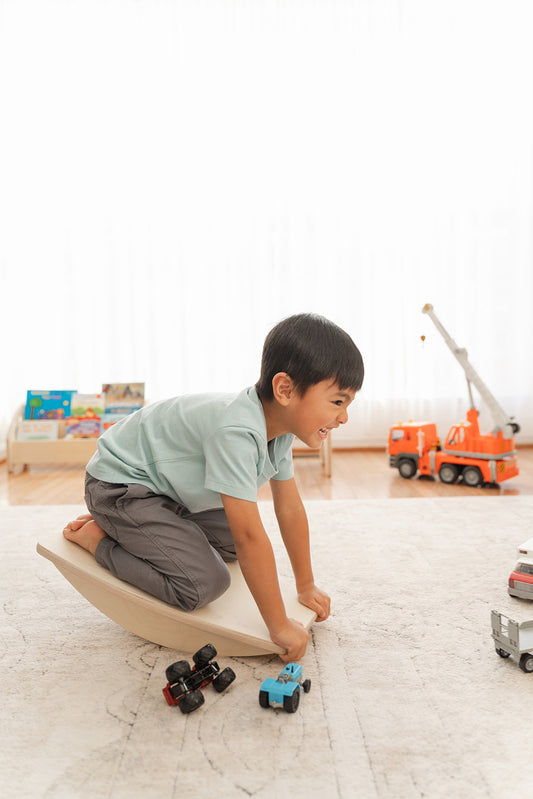
After bringing The Balance Board into our living room, here's what actually happened: it started as a toy — flipped over as a bridge for toy cars. Then gentle rocking during TV time. Then our daughter started reaching for it automatically when she needed to "think better." Her words, not ours.
For bedtime wind-down, 5–10 minutes of gentle rocking can help discharge excess energy and prepare the nervous system for sleep. The vestibular input signals to the brain that it's time to transition to a calmer state.

The Balance Board
Handcrafted in the USA from Baltic birch. Designed for kids ages 2–7, with a wide curved base that builds confidence from day one.
Shop The Balance Board — $99 →5 Why The Blueberry and Third Balance Board
We tried three different balance boards before designing our own. Here's what sets ours apart for sensory-seeking and ADHD kids specifically:
What makes it the right fit:
- Sized for kids ages 2–7 — not too tall, not too easy. The sweet spot for building real balance skills
- Wide curved base — secure enough for nervous beginners, still challenging enough to engage the vestibular system properly
- Smooth natural wood finish — feels good on bare feet, no sharp edges. Sensory-sensitive kids approved
- Doubles as open-ended toy — a bridge, a boat, a slide for toy cars. Value far beyond balance training
- Handcrafted in Ohio, USA — small family-owned business, not mass-produced overseas
- Beautiful enough for your living room — you won't want to hide it in the playroom
 Open-ended by design — it becomes whatever your child's imagination needs it to be.
6 Common Questions Parents Ask
Will it really help with focus, or is this just hype?
The research is solid. Multiple peer-reviewed studies show that vestibular stimulation improves attention in ADHD kids. It's not a miracle cure — it's a tool that supports focus alongside other strategies.
My child has terrible balance. Is this even safe?
Kids with poor balance often benefit the most. Start with supervised, gentle rocking and build confidence over time. The board helps them develop those skills safely and at their own pace.
How often should my child use it?
OTs recommend short, frequent sessions: 2–3 minutes before homework, 5–10 minutes during TV time, movement breaks every 20–30 minutes during long tasks, and 5–10 minutes before bed. Don't overthink it — let your child's interest guide you.
What if they only want to play with it, not use it for focus?
That's completely fine. Open-ended play is valuable. The benefits come from using it in any way — whether that's mindful balancing or pretending it's a surfboard. Let them lead.
My child also has sensory processing disorder. Will this help?
Yes — many kids with ADHD also have sensory processing challenges. Balance boards are frequently used in sensory integration therapy because they provide both vestibular and proprioceptive input, two key sensory systems that benefit from this kind of movement.
7 The Bottom Line

After reviewing the research, talking to therapists, and watching kids benefit from daily use, the answer is an emphatic yes. Balance boards are good for ADHD kids because they give the brain the movement it craves in a safe and controlled way, improve focus through vestibular stimulation, reduce impulsivity, calm anxiety, build confidence, and strengthen the core — all while kids think they're just playing.
And best of all? They think it's just fun.
Research Referenced
- "Balance-based Attentive Rehabilitation of Attention Networks (BARAN) improves executive functions and ameliorates behavioral symptoms in children with ADHD" — Heliyon, 2021
- "Multi-Sensory Balance Board for Children with SPD & ADHD Disorders" — PMC, 2021
- "Vestibular therapy improved motor planning, attention, and balance in children with ADHD: a randomized controlled trial" — Archives of Rehabilitation Research and Clinical Translation
- Clark DL, Arnold LE, et al. (2008) "Vestibular Stimulation for ADHD: randomized controlled trial of Comprehensive Motion Apparatus" — Journal of Attention Disorders
This article is for informational purposes only and is not a substitute for professional medical advice. Always consult with your child's healthcare provider before starting new interventions for ADHD.
Nikki Benbenek is the co-founder of Blueberry and Third, a Montessori-inspired children's furniture company handcrafted in the USA. She designs products at the intersection of child development and beautiful home design.