Co-Regulation Tips to Help Your Toddler Manage Their Feelings
Co-Regulation Tips to Help Your Toddler Manage Their Feelings — And Why Movement Is the Secret Ingredient
By Nikki Benbenek, Co-Founder of Blueberry and Third
My youngest had a meltdown last Tuesday over a cracker that broke. Not a dramatic cracker situation — just a regular cracker that snapped in half, which apparently was the end of the world at 10:47 in the morning.
If you have a toddler, you know exactly what I am talking about. And if you are in the thick of it, the meltdowns, the big emotions, the sheer exhaustion of managing feelings that seem disproportionate to everything, I want you to know: this is developmentally normal, you are not failing, and there is a framework that actually helps.
It is called co-regulation. And once I understood it, like really understood it,everything chnaged.

What Co-Regulation Actually Is
Co-regulation is not a technique for stopping tantrums. It is a relationship process. Co-regulation is defined as the process through which a child acquires self-regulation skills by interacting with a calm and trusted adult. It involves consistent modelling and teaching of essential self-regulatory strategies over time — rewiring the brain and equipping children with the ability to self-regulate in the long term. Blueberry and Third
The key word there is "calm." Your child's nervous system quite literally borrows regulation from yours. When you stay calm during a meltdown, genuinely calm, not performatively calm while you are seething internally, your child's nervous system has something to anchor to. Over time, with enough repetitions of this experience, they begin to internalize the ability to regulate themselves. But they cannot get there alone. They need you to get there first.
Children cannot self-regulate their emotions until they can co-regulate with a trusted adult. Co-regulation is the foundational step required for individuals to better understand their feelings and develop healthy ways to calm themselves. This is not a parenting philosophy. It is developmental neuroscience. And understanding it can transform the way you show up during the hardest moments of toddler life. Blueberry and Third

Why Movement Is the Secret Ingredient in Co-Regulation
Here is where it gets really interesting for those of us who care about how physical environment shapes emotional development. The fastest pathway to emotional regulation in a child — especially a toddler whose prefrontal cortex will not be fully developed for another two decades — is through the body, not the mind.
You cannot reason a toddler out of a meltdown. Their thinking brain has gone offline. What you can do is help their nervous system reset through movement, rhythm, and sensory input — which is exactly why OTs and PTs incorporate vestibular activities into emotional regulation support.
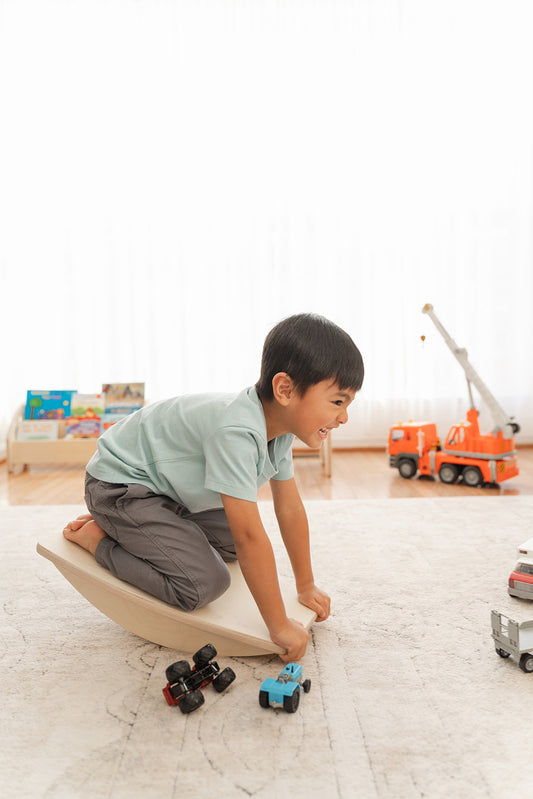
Calming activities like slow rocking movements can help children who feel overstimulated. By addressing sensory sensitivities, occupational therapists create a foundation for better emotional control. The rhythmic, side-to-side motion of the Wobble Beam provides exactly this kind of calming vestibular input — and making it available in the playroom or living room means your child has access to a self-regulation tool they can reach for before, during, and after big emotional moments. Ilslearningcorner

Practical Co-Regulation Tips That Actually Work
1. Regulate yourself first — always.
This is the hardest one, and the most important. Your calm presence is essential. Take deep breaths, use a soothing voice, and avoid getting frustrated. When your child is dysregulated and you escalate alongside them, even slightly, their nervous system reads your state and amplifies. When you stay anchored, they have something to come back to. Before you respond to a meltdown, take one breath. That single breath is not passive, it is the most active thing you can do. Blueberry and Third
2. Name the feeling without problem-solving.
Help them understand their emotions by labeling them: "I can see you are angry" or "you are really upset right now." It is not a time for teaching and threatening. Even if it seems trivial, acknowledge and label their emotions. Toddlers are not trying to manipulate you with their feelings — they are genuinely overwhelmed by them. When you name what you see, you help their brain begin to organize the experience, which is the first step toward regulation. Blueberry and Third
3. Offer movement before words.
When a toddler is in full meltdown, language is not the tool. Movement is. Offer a hug, a slow rock side to side, or access to a vestibular tool like the Wobble Beam — not as a distraction, but as a physiological reset. Slow rocking movements can help children who feel overstimulated return to a regulated state. You might rock together, or invite them to step on the Wobble Beam and shift their weight slowly. The rhythm does what words cannot. Ilslearningcorner
4. Create a calming corner they can access independently.
A calming corner is not a timeout corner — it is the opposite. It is a designated space in your home filled with tools that help your child regulate: soft lighting, a few comfort items, sensory tools, and movement options like the Wobble Beam or Balance Board. When children have a go-to place that is theirs — that they associate with feeling better — they begin to self-initiate regulation before the meltdown escalates. Occupational therapists incorporate calming techniques and sensory tools to create sensory-friendly environments that support the child's emotional and behavioral regulation, especially during stressful transitions. nih
5. Build a regulation routine into the daily schedule.
Meltdowns are often less about the cracker and more about the accumulation — hunger, overstimulation, transition fatigue, or a missed nap. Building consistent sensory and movement breaks into your day gives your child's nervous system regular opportunities to reset before they hit capacity. Ten minutes on the Wobble Beam before lunch, a slow walk before quiet time, a few minutes of deep pressure play before transitions — these are not luxuries. They are the nervous system maintenance that makes everything else in the day more manageable.
6. Stay curious after calm returns.
Once your child has regulated — not during, after — you can gently explore what happened. Not "why did you do that" but "it looked like you were feeling really frustrated earlier. What do you think was hard?" This builds emotional vocabulary and self-awareness over time, which is the foundation of long-term emotional intelligence. Co-regulation fosters strong communication skills as children learn to express their needs and feelings, and strengthens the bond between caregiver and child.

The Bigger Picture
Co-regulation is a long game. You are not going to do it perfectly every time — I certainly do not. There will be moments where you escalate, where you say the wrong thing, where the cracker situation undoes you too. What matters is the pattern over time. The more often your child experiences a calm adult presence during big feelings, the more their nervous system learns that big feelings are survivable, manageable, and temporary.
And the more you fill their physical environment with movement tools that support regulation — a Wobble Beam in the playroom, a calming corner with sensory options, a balance board for the high-energy moments — the more resources they have to reach for before they need you to rescue them.
That is the goal. Not perfect emotional regulation, but a child who has the tools, the trust, and the biological foundation to find their own way back to okay. It starts with you staying calm. It is supported by movement and sensory play. And it is built one co-regulated moment at a time.

Other references:
What Pediaitric PT and OTS Know About Balance
Secrets to Building Your Child's Self-Esteem
The Balance Beam is a STEM Toy and Here Is The Science To Prove It