What Pediatric OTs and PTs Know About Balance That Every Parent Should Too
What Pediatric OTs and PTs Know About Balance That Every Parent Should Too
By Nikki Benbenek, Co-Founder of Blueberry and Third
When we launched the Wobble Beam, I knew intuitively that it was something special, that the tilting, side-to-side motion was engaging children in a way that went beyond typical play. What I did not fully understand until we started hearing from pediatric occupational therapists and physical therapists who were recommending it to their patients was just how deeply rooted in science that intuition was.
What OTs and PTs know about balance — and what most parents do not — is that the vestibular system is not just about not falling over. It is the sensory foundation for almost everything a child does. And when we give children daily, purposeful balance play through tools like the Wobble Beam, we are not just strengthening their bodies. We are building their brains.
Here is what the research says, and why it matters for your child starting right now.

The Vestibular System — The Sensory Foundation Nobody Talks About Enough
The vestibular system is the sensory network located in the inner ear that detects movement, gravity, and spatial orientation. It tells your child where their body is in space, whether they are moving or still, and how to adjust their balance in response to an unstable surface. It is one of the earliest sensory systems to develop, beginning in the womb — and it has an outsized influence on everything from gross motor coordination to attention, emotional regulation, and cognitive function.
Pediatric occupational and physical therapists support children with vestibular processing challenges by incorporating targeted vestibular input into therapy sessions designed to improve balance, coordination, and spatial awareness, building the foundational skills needed for everyday tasks. When the vestibular system is well-developed and well-regulated, children can sit still in a classroom, focus on a task, transition between activities without melting down, and navigate physical environments with confidence and ease. When it is underdeveloped or dysregulated — which is increasingly common in children who spend more time in seats and strollers than in active free movement, the effects show up everywhere: poor balance, difficulty focusing, emotional dysregulation, sensory-seeking behavior, and clumsiness. Blueberry and Third
The good news is that the vestibular system responds readily to the right kind of input. And the right kind of input for toddlers is exactly what the Wobble Beam provides.

What the Wobble Beam Does — From an OT and PT Perspective
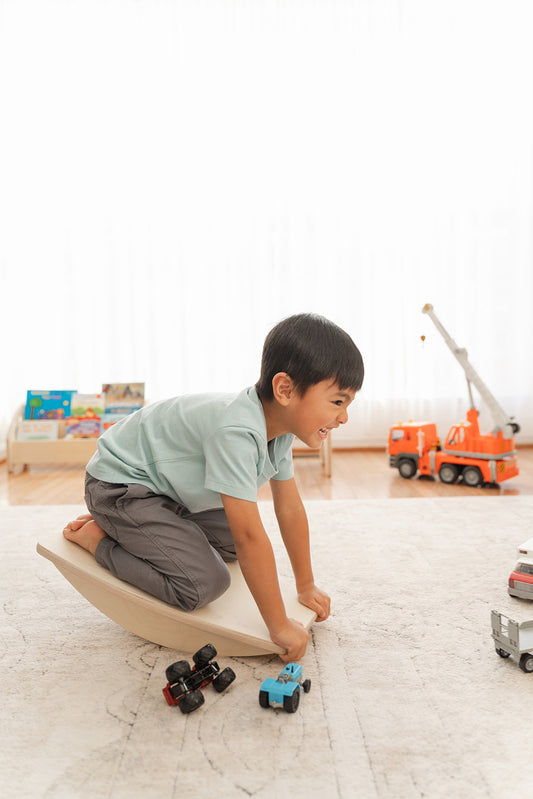
The Wobble Beam is a tilting wooden balance beam that rocks side to side as a child walks across it. That tilting motion is not incidental to the design — it is the entire developmental point. Every time the beam shifts under your child's feet, their vestibular system fires. Their brain receives information about their body's position in space and issues rapid adjustments to postural muscles to maintain balance. Their eyes recalibrate. Their core engages. Their proprioceptive system, the sensory network that tells the brain where the body's parts are relative to each other, activates alongside the vestibular system to coordinate the whole response.
Balance challenges like walking on a balance beam or using a wobble board encourage vestibular adaptation and postural control, helping children develop better balance and coordination. When children receive the right amount of vestibular input, benefits include improved focus and attention, better coordination, reduced sensory-seeking behaviors, and more emotional regulation with fewer meltdowns and a greater ability to self-soothe. Blueberry and Third
For typically developing toddlers, this means the Wobble Beam is building the neural pathways that support handwriting, sports, playground navigation, and classroom readiness, all before kindergarten, all through play. For sensory-seeking children and children with ADHD, it means something even more immediate: a productive, purposeful outlet for the vestibular craving that drives the climbing, spinning, crashing, and bouncing that can make daily life challenging for everyone in the house.

The ADHD and Sensory Processing Connection
One of the most significant bodies of research supporting balance play involves children with attention challenges and sensory processing differences. Vestibular therapy and movement-based interventions are backed by decades of research in occupational therapy, neuroscience, and pediatric development, demonstrating that structured vestibular input can help children improve focus, balance, coordination, and emotional regulation. Blueberry and Third
A randomized controlled trial published in a peer-reviewed occupational therapy journal found that vestibular training — which included balance beam walking as a core activity — improved motor planning, attention, and balance in children with attention deficit hyperactivity disorders. For children whose nervous systems are constantly seeking movement input, the Wobble Beam provides the regulatory feedback that calms the system rather than escalating it — making it one of the most recommended sensory tools by pediatric OTs working with children who have ADHD, sensory processing disorder, and autism spectrum disorder. Blueberry and Third
The key is that the input is controlled and purposeful. Climbing furniture or spinning in circles provides vestibular input but in an unstructured, often overstimulating way. The Wobble Beam provides the same sensory engagement in a focused, graded format — the right amount of challenge, in the right direction, at the right intensity for a developing nervous system.

How to Use the Wobble Beam at Home — An OT-Informed Approach
You do not need a therapy degree to give your child the vestibular benefits of the Wobble Beam. Here is how to use it intentionally at home, informed by what OTs and PTs recommend.
Start with short sessions. For toddlers aged 12 to 18 months, introduce the Wobble Beam with your hands available — not holding, but ready — and let them walk across with support at first. The goal is engagement, not perfection. Five minutes of intentional balance play has measurable vestibular benefit.
Use it before focused tasks. If your toddler struggles to sit for meals, storytime, or any focused activity, a short session on the Wobble Beam beforehand can provide the vestibular regulation that makes settling down easier. OTs call this a sensory diet — providing the right input before the right activity.
Build it into a movement circuit. Pair the Wobble Beam with the Balance Board and modular Balance Beam for a full Montessori obstacle course that provides a complete range of vestibular and proprioceptive input. Rotate the configurations regularly so the challenge continues to evolve as your child's skills grow.

Use it as a calming tool. For children who need to regulate after big emotions, slow rocking on the Wobble Beam — or even just standing on it and shifting weight gently — can provide the calming vestibular input that helps the nervous system reset.
Let them lead. The best vestibular play is child-directed. Set the Wobble Beam out in the playroom or living room where it is accessible and visible, and watch how often your child gravitates toward it on their own. Children seek the input their nervous systems need — and a child who keeps coming back to the Wobble Beam is telling you something important about what their brain is asking for.
The Wobble Beam is not just a toddler toy. It is a therapeutic movement tool built into a beautiful piece of solid wood children's furniture that earns its place in your home every single day. Built in Ohio, endorsed by pediatric OTs and PTs, and loved by the children who use it — this is the balance beam that changes how you think about play.
Kids Playroom Design and Why Balance Has Come First
How to Create a Montessori Movement Area At Home
What Age is Best For Balance Board
Best Wooden Toys for 2 Year Olds.. and Why The Balance Board Tops the List