The Secret to Getting Multiple Kids in the Kitchen (Without Losing Your Mind)
The Secret to Getting Multiple Kids in the Kitchen (Without Losing Your Mind)
By Nikki, Co-Founder of Blueberry and Third | Mom to a 6-year-old and 4-year-old
Let me paint you a picture.
It's 5:47 PM on a Tuesday. I'm trying to get dinner on the table before the "Hanger" meltdowns begin. My 6-year-old is twirling around the kitchen: "Mom, I want to help make the pasta" and my 4-year-old immediately starts wailing: "NO! I want to do it! You did it yesterday!"
Meanwhile, I'm standing at the counter with a knife in one hand, a crying preschooler attached to my leg, and a kindergartener pushing a single-child step stool across the kitchen floor.
"Just wait your turn," I tell them, already exhausted.
"But I'm HUNGRY," the 6-year-old whines.
"Me TOO!" echoes the 4-year-old.
And just like that, "helping in the kitchen" has devolved into a full-blown sibling argument over a step stool.
Sound familiar?
If you have more than one child who wants to be involved in the kitchen (or bathroom, or literally anywhere they need counter height), you know exactly what I'm talking about. That's why we designed The Double Stool
Why Getting Kids in the Kitchen Actually Matters
Before I dive into the solution that changed our family's entire kitchen dynamic, let me tell you why I kept trying—even through the chaos, the fighting, and the "it would be faster if I just did it myself" moments.
Getting kids involved in the kitchen isn't just about keeping them busy or teaching them to cook (though those are great bonuses).
It's about:
Life skills that last forever. My kids are learning to wash vegetables, crack eggs, measure ingredients, and understand where food comes from. These aren't just "kid activities"—they're foundational skills they'll use their entire lives.
Confidence and independence. When my 4-year-old successfully washes her hands at the bathroom sink by herself using a step stool? The pride on her face is incredible. When my 6-year-old helps me make pancakes and then tells her dad, "I made these!"—that's confidence being built in real-time.
Family bonding that doesn't feel forced. Here's the thing: my kids don't always want to "do a craft" or "play a board game" with me. But they always want to be where I am. And when I'm making dinner? They want in on the action. Cooking together has become our natural bonding time—no pressure, just side-by-side collaboration.
Reducing picky eating. Kids who help prepare food are more likely to try it. I can't tell you how many times my daughter has eaten vegetables she "doesn't like" because she helped wash and cut them. There's magic in ownership.
So yeah, getting kids in the kitchen matters. A lot.
But the logistics? Those were killing me.
The Single Step Stool Problem
For the longest time, we had a standard single-width step stool.
You know the kind—12-14 inches wide, two steps, perfectly functional for one child.
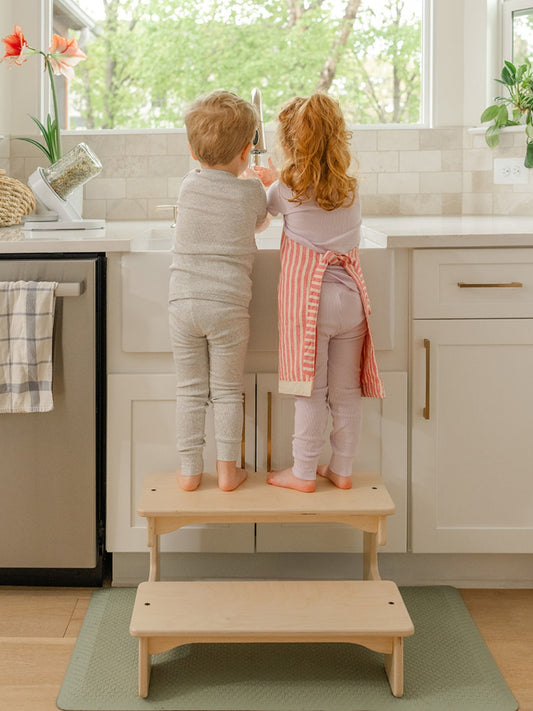
And that was the problem: one child. Hence another reason, The Double Stool is so popular amongst families (fits two kids side-by-side!)
Every single time we were in the kitchen, it was a battle over who got to use the stool.
"I was using it first!"
"But you've been on it forEVER!"
"Mama, tell her it's MY turn!"
I tried everything:
- Setting timers (they ignored them)
- Buying a second identical stool (they fought over who got which one)
- Designating "helpers of the day" (endless arguments about fairness)
And honestly? Even when one kid was using the stool, the other was hovering nearby, waiting, getting increasingly impatient and disruptive.
Plus, there were the logistical nightmares:
When I needed both kids to wash their hands at the bathroom sink before dinner? One had to wait.
When we were baking and I wanted my 6-year-old to stir while my 4-year-old added chocolate chips? Impossible. Someone was always waiting on the floor, losing interest, or wandering off.
When we were getting ready for school and both kids needed to brush their teeth? Morning chaos multiplied.
I kept thinking: There has to be a better way.
Kitchen Towers: Not the Solution I Thought They'd Be
At one point, I seriously considered getting a kitchen tower (you know, those enclosed standing towers for kids).
They're popular. They're all over Instagram. They look useful kids under the age of 1.5 year old.
But here's why they didn't work for us:
They're HUGE. Learning towers have a massive footprint—usually 18-20 inches deep and wide. In our already-cramped kitchen, it would have been a permanent obstacle. Every time someone needed to open the dishwasher, access a cabinet, or just walk through? They'd be navigating around this giant tower.
They're designed for ONE child. Sure, some companies make double towers, but then you're talking about a piece of furniture that's my kids have outgrown when they barely turn 3 years old.
The age range is limited. Most learning towers are designed for toddlers—roughly 18 months to 3 years. Which meant my both my kids are already 3 years outgrown it. That's a big investment for a short window.
They prevent independence. Kids need help getting in and out of most towers. Which meant I was constantly lifting kids up or supervising exits. That's not independence—that's just adding more work for me.
They're not portable. Need the kid at counter height in the bathroom? Better carry the 30-pound tower down the hall. Want them to reach something in a closet? Good luck with that.
I wanted something that would: ✓ Fit both kids at once ✓ Work in multiple rooms ✓ Grow with them (not age out in 2 years) ✓ Allow them to get up and down independently ✓ Not take over my entire kitchen
And that's when I realized: we needed a double-wide step stool.
The Double Step Stool: A Total Game-Changer
When we designed The Double Stool, it was born directly from my own frustration as a mom of two.
I wanted both my kids to be able to help in the kitchen—at the same time—without fighting, without taking turns, without one of them sitting on the floor getting bored.
Here's what makes it different:
Two Kids, One Stool, Zero Fighting
The Double Stool is 22.5 inches wide.
That means both kids can stand at the sink, side by side, without crowding each other.
And honestly? This alone has been revolutionary.
Now when I'm making dinner, my 6-year-old can wash vegetables in the left side of the sink while my 4-year-old rinses dishes in the right side. They're working together, not competing.
Freedom to Get Up and Down Independently
This was huge for us.
At ages 4 and 6, my kids are in that stage where they need to feel capable. They want to do things themselves. They want autonomy.
With a learning tower, they'd need help getting in and out safely—especially as they got older it became harder and harder to get in and out.
But with the Double Stool? They just step up. And step down. Whenever they want. Fr
It Works Everywhere (Not Just the Kitchen)
Here's where the Double Stool really shines: it's not just a kitchen tool.
We move ours around constantly.
Kitchen (obviously): Washing vegetables, helping cook, reaching snacks in the pantry, "helping" unload the dishwasher (okay, mostly just rearranging the Tupperware, but still).
Bathroom: Handwashing, tooth brushing, face washing, hair brushing in front of the mirror. Both kids, same time, far less chaos during morning and bedtime routines.
Closets: Reaching clothes on higher rods, helping put away folded laundry, grabbing shoes from upper shelves. I love that they can access their own stuff without needing me to get it for them.
Craft room: Reaching art supplies, accessing the sink for washing paintbrushes, getting to materials stored on higher shelves.
Laundry room: Helping transfer clothes from washer to dryer (they stand on the stool and love this job).
The lightweight but sturdy design means even my 6-year-old can move it herself when she needs it somewhere. Which, again, independence. Love it.
It Actually Fits in Real Homes
Dimensions: 22.5 inches wide x 12 inches tall x 15 inches deep.
Compare that to most learning towers (18-20 inches wide, 18-20 inches deep, 36+ inches tall), and you'll see why this works better in actual kitchens.
The 12-inch height gives kids perfect counter access without being obnoxiously tall. The 15-inch depth means it doesn't stick out like a piece of furniture—it's a tool you can tuck next to the counter when not in use.
It Grows with Your Kids (Ages 3 Through Elementary School)
Recommended age: 3 years and up. Weight capacity: 200 pounds.
My 4-year-old uses it now and will continue using it through elementary school. My 6-year-old is the perfect age for it and will keep using it for years.
Unlike learning towers that kids outgrow by ages 3-4, the Double Stool remains useful as long as kids need a boost to reach counter height. For most families, that's through age 8-10.
And honestly? I use it too. Reaching the back of the top pantry shelf? Changing a lightbulb? Yep, it's my step stool now.
Hers' a direct link again to The Double Stool incase you missed it :)
What About the Single-Width Step Stool?
Now, if you only have one kid, or if your kids are spaced far apart in age, you absolutely don't need a double-wide stool.
We also make The Step Stool (single width), which is perfect for:
- One-child households
- Kids who are old enough that they're not competing for counter access
- Smaller kitchens where every inch of space matters
- Grandparents' houses (where kids aren't there constantly)
It has the same height (12 inches), same weight capacity (200 pounds), same durable Baltic birch construction, and same easy-on-easy-off independence.
But if you have multiple young kids (especially close in age) who want to be involved at the same time? The double width is absolutely worth it.
Final Thoughts: It's Not About Perfect Pinterest Moments
Let me be really clear: Getting kids in the kitchen isn't always magical.
Sometimes my 4-year-old loses interest halfway through and wanders off to play with her dolls.
Sometimes my 6-year-old gets frustrated when the pancake batter doesn't mix exactly how she wants.
Sometimes I genuinely do just need to make dinner fast and kids helping would slow me down.
And that's all okay.
This isn't about creating perfect Instagram moments of cherubic children perfectly measuring flour.
It's about creating a life where our kids see cooking as normal, where they feel capable and included, where we spend time together in the rhythms of everyday life.
The Double Stool isn't magic.
But it is a tool that made it possible for both my kids to be involved in the kitchen at the same time, without fighting, without me needing to mediate turns, and without taking over my entire kitchen.
And for our family? That's been absolutely worth it.
If you're in the same boat—multiple kids, one kitchen, a whole lot of "But I want to help TOO!" energy—maybe this is the missing piece for you, too.
Ready to make your kitchen work for multiple kids?
Shop The Step Stool (Single Width) →
P.S. If you have questions about whether the Double Stool or Single Stool is right for your family, feel free to reach out. I'm always happy to talk through what works best for your space and your kids' ages. We're all just trying to figure this parenting thing out together, right?