
What Age is Best for a Balance Board?
What Age is Best for a Balance Board? A Complete Guide from Toddlers to Elementary School
Written by Nikki, Co-Founder of Blueberry & Third | Last Updated: March 2026
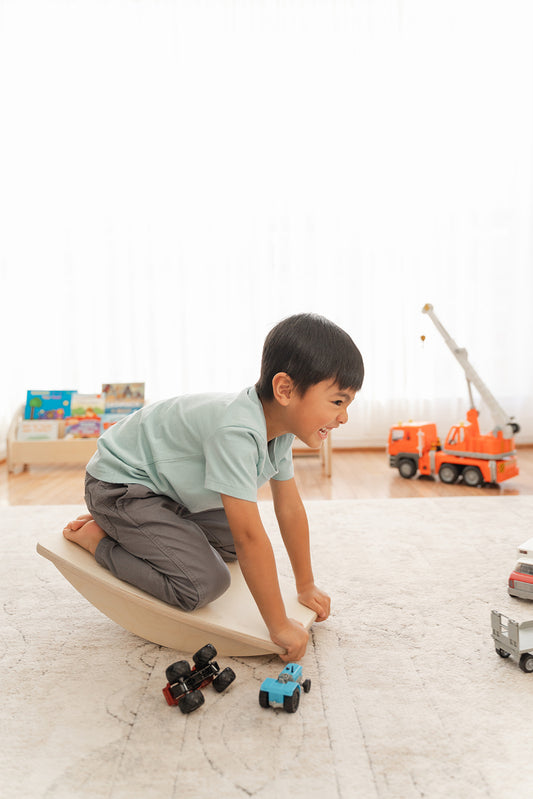
When my daughters were 2 and 4, I watched them use The Balance Board in countless ways, though imaginary play, to keep them regualted, and of course get the sillies out! That balance board became the most-used piece of furniture in our house, growing with them through completely different stages of childhood.
Parents ask me all the time: "What age should I get a balance board for my child?" The answer might surprise you: age 2 is the perfect time to introduce a balance board, and it'll remain valuable well into elementary school and beyond.
But here's what makes balance boards so special — they're not just for balance. They're tools for regulation, imagination, focus, and energy release that adapt to exactly what your child needs at each developmental stage.
Let me walk you through what that actually looks like, backed by research and real stories from families using our wooden balance board every single day.
Why Age 2 is the Perfect Time to Start
The short answer: Two-year-olds have developed enough core strength and balance to safely use a balance board with supervision, and introducing vestibular input at this age supports crucial gross motor development.
The longer answer: Between ages 2 and 3, toddlers are in a critical window for developing their vestibular system — the sensory system in the inner ear that controls balance, spatial orientation, and body awareness. According to research published in the Journal of Occupational Therapy, early vestibular stimulation during toddlerhood strengthens the neural pathways responsible for coordination, motor planning, and even attention regulation later in childhood.
Our balance board is specifically designed with a gentle curve and wide 20-inch platform that keeps toddlers close to the ground (just 4 inches high) while they're learning. This low-profile design means they're safe to explore rocking motions without the fear factor of being too high off the floor.

What Balance Boards Do for 2-3 Year Olds
At this age, balance boards are perfect for:
Physical Development:
- Strengthening core muscles and leg stability
- Developing proprioception (awareness of where their body is in space)
- Practicing weight shifting and balance control
- Building confidence in gross motor abilities
Cognitive & Emotional Growth:
- Teaching cause and effect ("When I lean this way, the board tips!")
- Building frustration tolerance through practice
- Developing body awareness and self-regulation
- Creating opportunities for mastery and pride
One of our customers, Hannah, shared: "This balance board has been so great for sensory play this winter. My boys have come up with fun games to play with the board plus get their energy out! I love how sturdy and durable it is for them!"

Safety First: Supervision for Young Toddlers
For children ages 2-3, always use the balance board with adult supervision. Place it on a soft surface like a rug, carpet, or playmat. We recommend bare feet for better grip and sensory feedback.
Most toddlers start by sitting on the board and gently rocking, then progress to kneeling, and eventually standing with support. There's no rush — let them explore at their own pace. The beauty of our wooden balance board is that it grows with them, so those early wobbly attempts turn into confident balancing within months.
Ages 2-4: The Imaginative Play Years
Here's where balance boards become absolute magic.
During the preschool years, children are in their peak imaginative play phase. Their brains are wired for make-believe, and they see possibilities in everything. That curved wooden board? It's never just a balance board.
In our house, I've watched our balance board transform into:
- A surfboard riding ocean waves
- A bridge for stuffed animals to cross
- A slide for toy cars and trains
- A pirate ship rocking on the high seas
- A magic carpet flying through the air
- A turtle shell to hide under
- A mountain to climb
- A rocket ship launching to space
- A reading chair that gently rocks
- A stage for puppet shows

This isn't just cute — it's developmentally crucial. According to pediatric occupational therapists, open-ended toys that support imaginative play strengthen creativity, problem-solving, language development, and emotional regulation.
Getting the Sillies Out: Vestibular Input for Energy Release
But let's talk about the real MVP function during these years: energy release.
If you have a high-energy toddler or preschooler (and honestly, is there any other kind?), you know that trapped indoor energy can make everyone miserable. The balance board becomes an instant outlet for that physical need to MOVE.
Research published in PMC on multi-sensory balance boards for children explains that rhythmic rocking provides exactly the kind of vestibular stimulation that helps children regulate their arousal levels. Translation: it helps them get energy out in a controlled way, rather than bouncing off furniture or having meltdowns from overstimulation.
As one parent, Amber B., shared in her review: "I'm so happy we got the balance board for our 2 year old! Gave it to him on his birthday and he was so excited! He loves balancing on it and gets a kick out of it when we join in on the fun too."

Pro tip from a mom of two: On rainy days when we couldn't get outside, I'd set a timer for "balance board dance parties." We'd put on music and the girls would rock, jump on and off, and move to the beat. It burned energy, improved their coordination, and honestly saved my sanity during those long winters.
Ages 4-6: The Transition to Purposeful Use
Something shifts around age 4-5. The imaginative play continues, but children also start using the balance board more purposefully for its actual function: balance and body regulation.
Building Balance Skills & Body Confidence
This is the age where you'll notice real progression in their balancing abilities. They go from needing support to standing independently, from basic rocking to more complex movements — standing on one foot, closing their eyes, or even trying to balance while catching a ball.
These aren't just party tricks. According to research from the Archives of Rehabilitation Research and Clinical Translation, vestibular therapy through balance boards improved motor planning, attention, and balance in children with attention difficulties. Those same benefits apply to all children — the balance board is strengthening neural pathways that support everything from riding a bike to handwriting.
The Focus Connection: How Balance Boards Help Concentration
Here's something fascinating I learned from our customers: many parents report using the balance board as a focus tool during this age.
One speech therapist, Aly R., reviewed our board saying: "I absolutely love this balance board and the versatility of it! It has so many uses and is very regulating for kids!"
Why does standing on a balance board help kids focus? It comes back to vestibular stimulation.
A 2021 study published in Heliyon titled "Balance-based Attentive Rehabilitation of Attention Networks (BARAN) improves executive functions and ameliorates behavioral symptoms in children with ADHD" found that balance-based interventions significantly improved attention networks in the brain.
The gentle rocking motion provides just enough sensory input to satisfy the body's need for movement while allowing the brain to focus on other tasks. Think of it like fidgeting, but productive — the body stays engaged while the mind can concentrate.

Ages 6-8: The Regulation & Focus Tool
By elementary school, the balance board transforms again — this time into a regulation and focus tool that helps kids stay grounded (literally and figuratively).
For Fidgety Kids: A Tool to Stay Put
If you have a fidgety child — one who can't sit still during homework, wiggles during dinner, or constantly shifts positions while reading — the balance board becomes invaluable.
Instead of fighting against their need to move, the balance board uses it.
Real-world examples from families:
- Standing on the balance board while watching TV or movies
- Rocking gently while reading books
- Using it as a "homework helper" under a standing desk
- Sitting on it during family game nights for calming input
- Gentle rocking before bed as part of a calming routine
How Balance Boards Help Children with ADHD
This is where the research gets really compelling.
Multiple peer-reviewed studies show that vestibular stimulation improves attention in children with ADHD. Here's why it works:
1. Provides Movement Without Distraction Children with ADHD often have an overwhelming need to move. The balance board satisfies that physical need in a controlled way, allowing them to focus their mental energy elsewhere.
2. Regulates the Sensory System The rhythmic rocking provides proprioceptive and vestibular input that helps organize the sensory system. This has a naturally calming effect and improves self-regulation.
3. Strengthens Mind-Body Connection Balancing requires constant micro-adjustments, building the neural pathways between thought and movement. This improved mind-body connection reduces impulsivity over time.
4. Offers a Constructive Outlet Instead of disruptive fidgeting (tapping pencils, bouncing knees, tipping chairs), the balance board channels that energy productively.
A study published in PMC on "Multi-Sensory Balance Board for Children with SPD & ADHD Disorders" concluded that balance boards are "a suitable tool for children and can also improve their self-confidence and stability, which is the combination of entertainment and exercises for the development of the sensory integration."
It's Not Just for ADHD
Even children without ADHD benefit from this regulation tool. All kids experience moments of:
- Restlessness during long car rides or screen time
- Difficulty winding down before bed
- Overwhelm from busy days or new situations
- Need for sensory input after sitting in school all day
The balance board becomes a go-to tool for those moments — a healthy, productive way to regulate their nervous system.
The Science Behind Balance Boards: Why They Work
Let me break down the research in plain English, because understanding why balance boards work makes them so much more valuable.
The Vestibular System: Your Child's Internal GPS
The vestibular system is located in the inner ear and controls:
- Balance and equilibrium
- Spatial orientation (knowing where you are in space)
- Coordination of eye movements with head movements
- Muscle tone and posture
- Arousal and alertness levels
When your child rocks on a balance board, they're sending signals to this system that say: "Pay attention! We're moving!" The brain then responds by:
- Engaging core muscles for stability
- Adjusting posture and weight distribution
- Processing sensory feedback from feet, joints, and inner ear
- Coordinating motor responses to maintain balance
This isn't passive play — it's active brain development.
Proprioception: Body Awareness in Action
Proprioception is your child's ability to know where their body is without looking. It's what lets them walk without watching their feet or reach for a glass without knocking it over.
Balance boards are proprioception powerhouses. Every rock, shift, and adjustment teaches children:
- How much force to use
- Where their center of gravity is
- How to respond to changes in position
- How different movements affect outcomes
According to motor development expert Mette Vainer Wegloop, "The more your child plays with their balance board, the easier it gets for them to coordinate body movements and flex the right muscles at the right times."
Core Strength: The Foundation of Everything
Core strength isn't just about abs — it's about the entire system of muscles that stabilize your trunk and pelvis. Strong cores support:
- Better posture (crucial for handwriting and desk work)
- Improved balance and coordination
- Reduced injury risk in sports and play
- Better breathing and digestion
- Enhanced athletic performance
The constant micro-adjustments required on a balance board engage these core muscles in a way that's fun and functional, building strength without the "work" of traditional exercise.
Choosing the Right Balance Board: What Actually Matters
Not all balance boards are created equal. After three years of designing, testing (thanks to my daughters' enthusiastic destruction attempts), and refining, here's what actually matters:
1. Wood Quality & Construction
Our balance board is made from 100% sustainably-sourced Baltic birch plywood — the same premium material used in our other furniture. Why does this matter?
- Strength: Baltic birch has exceptional strength-to-weight ratio, supporting up to 150 pounds
- Durability: Multiple plywood layers resist warping, cracking, and splitting
- Safety: NAF-certified (No Added Formaldehyde) means zero toxic off-gassing
- Longevity: Built to last through multiple children and years of daily use
Cheap balance boards often use lower-grade plywood or even particleboard, which can break unexpectedly — a serious safety concern.
2. Curve Design
The curve angle affects both safety and functionality:
- Too flat: Minimal rocking motion, limited vestibular input
- Too steep: Unstable and scary for young children
- Just right: Our 4-inch height provides satisfying rocking while keeping kids close to the ground for confidence
3. Surface Finish
We use water-based, non-toxic finishes that:
- Meet or exceed U.S. CPSC safety standards
- Provide smooth, splinter-free surfaces
- Are safe for bare feet (recommended for best grip)
- Are eco-friendly and child-safe
4. Size & Weight Capacity
Dimensions matter for both safety and longevity:
- 20" L x 11" W x 4" H: Perfect size for toddlers through elementary kids
- 150-pound weight capacity: Grows with children through age 8+ (and beyond)
- Compact storage: Slides under beds or against walls easily
5. Edges & Safety Features
Our board includes:
- Rounded edges (no sharp corners)
- Smooth, sanded surfaces
- Stable, wide base for confidence
- Low profile to minimize fall distance

Common Questions Parents Ask
"My child has poor balance — will this help or frustrate them?"
Actually, kids with poor balance often benefit the MOST from balance boards! The key is starting slow and building confidence gradually. The gentle rocking helps develop those balance skills in a safe, controlled way.
Occupational therapists specifically recommend balance boards for children with coordination difficulties because they provide immediate sensory feedback and lots of opportunities for success.
"How long should my child use it each day?"
There's no magic number — it depends entirely on your child and what they need.
Some kids use it for 5-minute energy bursts throughout the day. Others stand on it for 20-30 minutes while watching shows or reading. Both are great!
The beauty of our wooden balance board is that it becomes part of their natural play and routine, so they'll use it when their body needs it.
"Is it safe on hardwood floors?"
Yes, with a rug or mat underneath! We recommend placing the balance board on:
- Carpet or area rugs (provides cushioning)
- Yoga mats or playmats (protects floors from scratches)
- Foam gym tiles (ideal for dedicated play spaces)
This protects both your floors and provides a softer landing if they lose balance.
"What if my child just uses it for imaginative play and never actually balances?"
That's totally fine! Open-ended play is incredibly valuable for development. The benefits come from using it in ANY way — whether that's mindful balancing or pretending it's a surfboard.
Trust that as they grow, they'll naturally discover different uses. My daughters went through a solid six-month "car ramp" phase before they got interested in actual balancing. Both were valuable play experiences.
"Can adults use it too?"
Absolutely! Our balance board supports up to 150 pounds, and many parents use it themselves for:
- Core strengthening exercises
- Standing desk movement
- Physical therapy and rehab
- Meditation and mindfulness
- Demonstrating techniques for kids
Why Our Balance Board is Different
I'm not going to pretend we're the only balance board option out there — we're not. But after designing furniture for three years and testing everything with my own daughters, here's what makes our balance board special:
1. It's Built to Last Generations
This isn't a $30 toy that breaks after three months. It's heirloom-quality furniture built with:
- Premium Baltic birch plywood
- Reinforced construction techniques
- Quality control from our US woodshops
- 150-pound weight capacity for longevity
We've had customers tell us their balance boards survived three kids and still looked good enough to pass on to the neighbors.
2. Safety is Non-Negotiable
Every board is:
- Lab-tested for safety standards
- Finished with non-toxic, water-based coatings
- Sanded to perfect smoothness (no splinters)
- Designed with rounded edges and stable base
- NAF-certified (zero formaldehyde)
As a mom, I wouldn't sell anything I wouldn't give my own daughters.
3. Made in America
Our balance boards are handcrafted in a small Ohio woodshop, supporting:
- American craftsmanship and jobs
- Reduced carbon footprint (no overseas shipping)
- Quality control and fair labor practices
- Local economy and community
4. Sustainable & Eco-Friendly
Every purchase includes:
- Sustainably-sourced wood materials
- 100% plastic-free packaging
- One tree planted
- Three ocean-bound plastic bottles rescued
We're building a company our kids can be proud of.
5. It Actually Works
The proof is in the reviews:
"Great for boy moms! This balance board has been so great for sensory play this winter. My boys have come up with fun games to play with the board plus get their energy out! I love how sturdy and durable it is for them!" — Hannah
"We love the balance board! I'm so happy we got the balance board for our 2 year old! Gave it to him on his birthday and he was so excited! He loves balancing on it and gets a kick out of it when we join in on the fun too. Can't wait to get him the balance beam next! Blueberry & Third is my go to for items like this!!" — Amber B.
"Speech Therapist Approved! I absolutely love this balance board and the versatility of it! It has so many uses and is very regulating for kids!" — Aly R.

The Bottom Line: Is a Balance Board Worth It?
Here's my honest answer as both a founder and a mom:
Yes — if you want a single piece of play equipment that:
- Grows with your child from toddlerhood through elementary school
- Supports physical, cognitive, and emotional development
- Provides endless opportunities for open-ended play
- Helps with energy regulation and focus
- Is built to last through multiple children
- Offers therapeutic benefits backed by research
Maybe not — if you're looking for:
- Something that keeps kids occupied for hours at a time (it's not screen time)
- A toy with lights, sounds, and prescribed play patterns
- The absolute cheapest option available
- Something that guarantees immediate, dramatic results
The truth is, a balance board is an investment — in your child's development, in quality over quantity, in sustainable play over disposable toys.
Ready to Try a Balance Board?
If you're ready to add a balance board to your home, we'd love to have you join the Blueberry & Third family.
Our wooden balance board includes:
✓ Premium Baltic birch construction
✓ Non-toxic, water-based finishes
✓ 150-pound weight capacity
✓ Recommended ages 2-7+ years
✓ 20" L x 11" W x 4" H dimensions
✓ Handcrafted in Ohio, USA
✓ Ready to use right out of the box (no assembly!)
✓ One tree planted + 3 plastic bottles rescued per purchase
Price: $99.00 USD (with free shipping on orders over $150)
Final Thoughts from One Parent to Another
Starting around age 2, a balance board becomes more than just a toy — it becomes a companion through childhood's biggest developmental leaps.
It's there for the toddler learning to balance on wobbly legs.
It's there for the preschooler turning everything into a grand adventure.
It's there for the kindergartener who needs to wiggle while listening to stories.
It's there for the elementary student who discovers it helps them focus on homework.
And it's there for all the in-between moments — the rainy days, the restless evenings, the times when little bodies just need to MOVE.
Will it solve every problem? No. Will your child use it every single day? Maybe, maybe not.
But will it support their development, give them a healthy outlet for energy, and provide years of value?
Absolutely.
If you have questions about whether a balance board is right for your family, please reach out. I'm here Monday through Friday, 9 a.m. - 4 p.m. EST at hello@blueberryandthird.com.
I love talking to parents about what works (and what doesn't) for real families with real kids.
Thanks for being here, and thanks for prioritizing quality, safety, and intentional play in your home.
— Nikki
Co-Founder, Blueberry & Third
Mom to two balance board enthusiasts (ages 6 and 4)
Frequently Asked Questions
Q: What's the weight limit on the balance board?
A: Our balance board supports up to 150 pounds, making it suitable for children ages 2-8+ and even many adults.
Q: What materials is it made from?
A: 100% sustainably-sourced Baltic birch plywood with non-toxic, water-based finishes. NAF-certified (No Added Formaldehyde) and exceeds U.S. CPSC safety standards.
Q: How big is it?
A: 20 inches long x 11 inches wide x 4 inches high — perfectly sized for toddlers through elementary kids while remaining compact for storage.
Q: Does it need assembly?
A: Nope! It arrives fully assembled and ready to use right out of the box.
Q: Can it be used on hardwood floors?
A: Yes, we recommend placing it on a rug, carpet, or playmat for both floor protection and safety cushioning.
Q: Is it safe for a 2-year-old?
A: Yes! With adult supervision, 2-year-olds can safely explore the balance board. The low 4-inch height and wide base keep them close to the ground while learning.
Q: How do I clean it?
A: Simply wipe with a damp cloth and mild soap, then dry completely. Avoid soaking or submerging in water.
Q: What if my child has ADHD or sensory processing needs?
A: Balance boards are specifically recommended by occupational therapists for children with ADHD and sensory processing differences. The vestibular input helps with regulation and focus.
Q: Will it help my child's balance improve?
A: Yes! Regular use specifically develops balance skills, core strength, and body awareness through active vestibular play.
Q: What's your return policy?
A: We offer full refunds on unused items (minus a $25 return-shipping + restock fee) within 30 days of delivery.
Related Articles
- Are Balance Boards Good for ADHD Kids?
- Understanding Vestibular Input and Why It Matters
- Creating a Montessori Movement Area at Home
- The Best Gross Motor Toys for Toddlers and Preschoolers
Research References
- "Balance-based Attentive Rehabilitation of Attention Networks (BARAN) improves executive functions and ameliorates behavioral symptoms in children with ADHD" - Heliyon, 2021
- "Multi-Sensory Balance Board for Children with SPD & ADHD Disorders" - PMC, 2021
- "Vestibular therapy improved motor planning, attention, and balance in children with attention deficit hyperactivity disorders: a randomized controlled trial" - Archives of Rehabilitation Research and Clinical Translation
- Wegloop, M.V. "Why a Balance Board is so Brilliant" - FLEXA Insight, 2023
- "Balance Board Math: Exploring the Sense of Balance as a Basis for Functions and Graphing" - Digital Experiences in Mathematics Education, 2024
Shop Our Balance Board:
Click here to see our handcrafted wooden balance board
Questions?
Email us: hello@blueberryandthird.com
Monday-Friday, 9 a.m. - 4 p.m. EST
This blog post contains information based on current research and our experience working with families. Always consult your pediatrician or occupational therapist for specific advice about your child's development and needs.