Why Forward-Facing Bookshelves Changed Everything in Our Home (And Will Transform Yours Too)
Why Forward-Facing Bookshelves Changed Everything in Our Home (And Will Transform Yours Too)
By Nikki, Founder of Blueberry and Third | Mom to a 6-year-old and 4-year-old
I'll never forget the moment I realized we had a problem.
My daughter was 18 months old, sitting in front of our traditional bookshelf—you know, the kind where books are shelved spine-out like a tiny library. She'd pull one book out, toss it aside, pull another, toss it aside. Within minutes, there was a pile of discarded books on the floor and tears of frustration. She wanted a book. She just had no idea which one.
That's when it hit me: she couldn't see the covers.
To her, those colorful spines were just... lines. Abstract patterns. They meant nothing. She couldn't identify "The Very Hungry Caterpillar" by its skinny green spine any more than I could pick out a specific file in a filing cabinet without reading the labels.
That weekend, I bought our first forward-facing bookshelf. And I'm not exaggerating when I say it changed our entire reading routine.
Now, as a mom of two (ages 6 and 4) and Co-Founder of Blueberry and Third, where we make a floor display bookshelf, I want to share why forward-facing book storage isn't just "cute nursery decor." It's actually one of the smartest developmental tools you can add to your home.
Let me explain.
What Makes Forward-Facing Bookshelves Different?
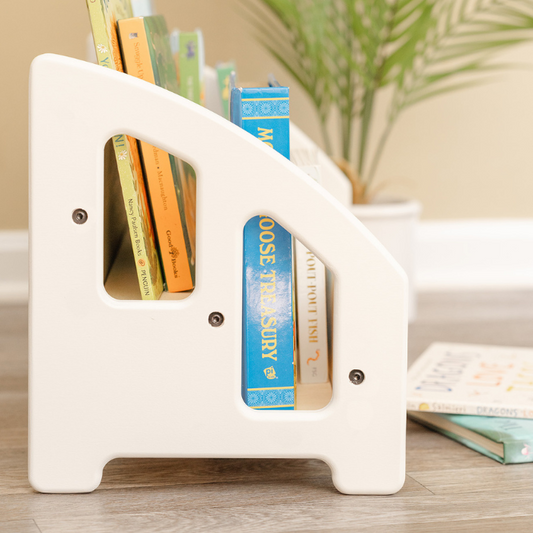
A forward-facing bookshelf (sometimes called a front-facing bookshelf, picture book display, or Montessori bookshelf) stores books with the covers facing out, not the spines. Think of how bookstores display bestsellers in the front window. That's the idea.
Instead of this: ||||||| (spines lined up)
You get this: [COVER] [COVER] [COVER] (full covers visible)
The difference seems small. But for babies and toddlers learning to make choices, recognize patterns, and build independence? It's huge.
Why Babies and Toddlers Need to See Book Covers
1. Visual Recognition Comes Before Reading
Babies recognize images long before they can read words.
When my daughter was 10 months old, she couldn't say "Goodnight Moon." But she could spot that iconic green cover from across the room and crawl over, pointing excitedly. That blue and orange "Goodnight Moon" cover? That was her signal: This is the bedtime book. This is the one I love.
The science behind it: Research shows that infants as young as 6 months can recognize and remember images. By 12-18 months, they're making visual associations between pictures and concepts. When book covers are visible, toddlers can:
- Identify favorite books by cover art, not title
- Make independent choices based on what appeals to them visually
- Develop preferences (my daughter went through a solid month where she'd only pick books with animals on the cover)
- Build confidence in their ability to choose and retrieve items on their own
With traditional shelving, where only spines show? They're guessing. Or worse, they're pulling out every single book to find the one they want. (Hello, daily book avalanche.)
2. It Encourages Self-Directed Reading (The Montessori Magic)
Here's where the Montessori philosophy comes in—and why I'm obsessed with it.
Montessori principle: Children thrive when they have access to materials at their level, can make independent choices, and experience the natural consequences of those choices.
A forward-facing bookshelf puts books within reach—both literally and cognitively.
Traditional bookshelf: Child asks parent for help → Parent pulls book → Child is passive
Forward-facing bookshelf: Child sees cover → Child recognizes book → Child retrieves book independently → Child feels capable and confident
This isn't just about reading. It's about autonomy.
When my 4-year-old can walk over to the bookshelf, see "Dragons Love Tacos" (her current obsession), pull it down, and settle into the reading nook without asking for help—that's independence. That's her learning that she's capable. That she can meet her own needs.
And for parents? It means fewer requests for "Mama, get me a book!" throughout the day. (Small win, but I'll take it.)
3. It Naturally Rotates Favorites to the Front
One of my favorite unexpected benefits of forward-facing storage: it creates a natural rotation system.
Because while the bookshelf can fit several books, you can only display 4-6 books per shelf (depending on the size of book), you're forced to curate. And here's what I learned: that's actually perfect for young children.
Babies and toddlers don't need access to 50 books at once. In fact, too many choices can be overwhelming. They do better with a small, rotating selection of favorites.
Every few weeks, I swap out 2-3 books. Old favorites go into storage, and "new" books (really just books they haven't seen in a while) get rotated in.
To them? It feels like getting new books constantly. To me? I'm not drowning in a pile of 80 picture books that nobody's touching.
Pro tip: visit your local library for a bay library card, making book rotation free and easy!
How Forward-Facing Bookshelves Grow With Your Child
When we designed The Bookshelf at Blueberry and Third, I wanted something that wouldn't become obsolete after the baby phase. Because let's be honest—kids' furniture is an investment, and I didn't want another item that would be donated at age 3.
Here's how forward-facing book storage evolves as your child grows:
Ages 0-18 Months: Visual Stimulation and Exploration
At this age, books are toys. And that's perfect.
What they're doing: Babies are grabbing, mouthing, flipping pages (often in the wrong direction), and mostly just exploring the physical object of a book.
Why forward-facing works:
- High-contrast book covers (think "Black and White" board books) provide visual stimulation
- Babies can see which books are available and start to recognize familiar covers
- Parents can easily grab a book for tummy time, diaper changes, or calming fussy moments
Our setup at this age: Board books only on the bottom two shelves. Lots of textures (touch-and-feel books), high-contrast images, and books with baby faces (babies love looking at other babies).
The Bookshelf sits in the nursery next to the rocking chair. During bedtime routine, I'd pull a book right from the shelf without leaving the chair. Game-changer for those exhausted 3am wake-ups.
Ages 18 Months - 3 Years: Independence and Choice-Making
This is the golden age for forward-facing shelves.
What they're doing: Toddlers are asserting independence, making choices, and developing strong preferences. They want to pick. They want to do it themselves. They want THE BLUE BOOK, not the red one, and they will melt down if you get it wrong.
Why forward-facing works:
- They can identify books by cover and retrieve them independently
- Reduces tantrums from "I can't find the book I want!"
- Builds confidence and problem-solving skills
- Encourages the "I can do it myself!" phase in a positive way
Our setup at this age: Bottom shelf: Toddler favorites (we went through a serious "Don't Let the Pigeon Drive the Bus" phase)
Middle shelf: Books I wanted to introduce or seasonal themes
Top shelf: Still parent-controlled for books that needed supervision or weren't age-appropriate yet
The bookshelf moved from the nursery to the playroom. My daughter would grab books, bring them to her little reading chair, "read" to herself (make up stories based on pictures), and then carefully put them back. I'm not going to lie—watching her put books back on the shelf felt like a minor parenting miracle.
Ages 3-5 Years: Pre-Reading and Early Literacy
This is where things get really exciting.
What they're doing: Preschoolers are starting to recognize letters, memorize favorite books word-for-word, and "pretend read" to younger siblings or stuffed animals. They're also developing longer attention spans for storytelling.
Why forward-facing works:
- They can see book covers and start making connections: "That one has a dinosaur on it—it's probably about dinosaurs!"
- They're learning to navigate choices and build personal reading preferences
- The act of selecting, reading, and re-shelving becomes part of their routine
- They can help with the rotation process ("Which books should we put away this week?")
Our setup at this age: We moved The Bookshelf from the playroom to the living room, right next to the couch.
Why? Because bedtime reading was happening upstairs, but family reading time was happening downstairs in the evenings. Having books visible and accessible in the main living space meant my kids would grab books during the day, during that pre-dinner "witching hour," or while I was cooking.
(Also, real talk: I got tired of running upstairs 47 times a day to grab books. Having them in the living room was a sanity-saver.)
Ages 5-7 Years: Early Readers and Chapter Books
Here's where I thought forward-facing shelving would phase out. Turns out? Still useful.
What they're doing: My 6-year-old is now reading independently. She's moved into early chapter books but still loves picture books (and honestly, so do I)
Why forward-facing still works:
- She can see her chapter books displayed (we spotlight her current read on the top shelf)
- Picture books are still accessible for when she wants to "read" to her younger brother
- She takes pride in organizing her favorite books with covers out
- It's become a display for books she's proud to show off ("Look! I finished this one!")
The Real-World Benefits I Didn't Expect
Beyond the developmental stuff and Montessori philosophy, there were some practical, day-to-day benefits I didn't anticipate:
1. Less Clutter
Because you can only display a limited number of books at once, I became more intentional about what we kept out. Instead of 60 books crammed onto shelves (half of which were ignored), we kept 15-20 in active rotation.
The rest? Stored in bins in the closet. Out of sight, ready to rotate back in later.
Result: Our playroom and living room felt so much less chaotic.
2. Books Became Decor
I know this sounds superficial, but hear me me out.
Picture book covers are beautiful. The art in kids' books today—especially from independent publishers—is museum-quality. When books are displayed forward-facing, they become part of your home's aesthetic.
Our living room bookshelf looks good. It's not just functional; it's actually pretty. And because it's pretty, I don't mind it being in the main living space instead of hidden in a playroom.
(Also, guests comment on it constantly. "Where did you get that bookshelf?" is something I hear at least once a week.)
3. My Kids Actually Put Books Back
This one still amazes me.
With traditional shelving, re-shelving books is hard for little kids. They have to orient the book correctly (spine out), slide it in between other books, make sure it doesn't fall… it's a whole thing.
With forward-facing shelves? You literally just set the book down in the slot. That's it.
My 4-year-old can do it. My 6-year-old has been doing it for years. And because it's easy, they actually do it without being nagged.
I never thought I'd see the day when my kids would consistently put books away without me asking. But here we are.
4. Capacity and Rotation-Friendly Design
How many books can it hold? And how easy is it to swap books in and out?
Look for: At least 3-4 shelves with space for 4-6 books per shelf. This gives you flexibility to rotate without constantly shuffling things around.
Our bookshelf: Four shelves, each holding 4-6 books depending on thickness. Total capacity: 16-24 books. Perfect for active rotation without overwhelming young kids with choices.
5. Longevity
Will this work for babies and elementary schoolers? Or will you outgrow it in two years?
Look for: Timeless design that works across age ranges. Natural wood finish (blends into any room style). Quality construction that can handle years of daily use.
Our bookshelf: I designed it to look good in a nursery, a playroom, and a living room. Natural wood with a clean, simple silhouette. And because it's made from real birch plywood (not laminate), it actually gets better with age—develops a nice patina, minor scuffs blend in, it becomes part of your home's story.
We've had ours for four years and it still looks great.
Where to Put a Forward-Facing Bookshelf (And Why It Matters)
Location makes a huge difference in how much your bookshelf gets used. Here's where we've tried it—and what worked best:
Option 1: The Nursery (Ages 0-2)
Pros:
- Convenient for bedtime stories
- Creates a dedicated reading corner
- Books are part of the calm bedtime routine
Cons:
- Books may not get used during the day
- Takes up space in a room you're trying to keep minimal
Our verdict: Great for the first 18 months, then it's time to move it.
Option 2: The Playroom (Ages 2-4)
Pros:
- Kids naturally go to books during play
- Easy to incorporate into independent play routine
- Keeps books separate from toy chaos
Cons:
- If your playroom is upstairs or in a separate area, books might not be part of daily life outside of "playtime"
Our verdict: Perfect for toddlers who spend a lot of time in a dedicated play space.
Option 3: The Living Room (Ages 3+) Our Favorite
Pros:
- Books become part of family life, not just "kid time"
- Accessible during the day, evening, and weekends
- Encourages spontaneous reading (my kids will grab books while I'm making dinner)
- Models reading as a normal, everyday activity
Cons:
- You need a bookshelf that looks good in your main living space (not all kids' furniture does)
Option 4: Next to the Couch (For Family Reading Time)
This is our exact setup, and I love it.
We keep the bookshelf right next to our sectional couch. Why?
- After dinner, we all pile on the couch for family reading time
- Kids can grab books without getting up
- I can reach over and grab a book if they're being indecisive ("How about this one?")
- It's become part of our evening routine: dinner → couch → books → bedtime
Pro tip: If you're putting the bookshelf in a main living area, make sure it's something you actually like looking at. We designed ours to be simple, natural, and non-plastic specifically so it wouldn't look like "kid stuff" taking over our living room.
Real Talk: Is It Worth the Investment?
Look, I'm not going to tell you that you need a forward-facing bookshelf. Plenty of kids grow up loving books with traditional shelving.
But here's what I will say:
If you're trying to encourage independent reading, reduce daily chaos, and create an environment where your child feels capable and confident—a forward-facing bookshelf is one of the best investments you can make.
We use ours every single day. Four years in, multiple kids, and it's still one of the most-used pieces of furniture in our house.
And here's the thing: unlike a lot of baby gear that gets used for 6 months and then donated, a well-made forward-facing bookshelf grows with your family. You'll use it in the nursery, the playroom, the living room. You'll use it for board books, picture books, early readers, chapter books.
Cost per use? Incredibly low.
Impact on daily reading habits? Incredibly high.
Why We Made The Bookshelf (And Why It's Different)
When we started Blueberry and Third, I knew a forward-facing bookshelf had to be one of our first products. Because I'd lived the difference it made in our home. I'd seen my kids go from frustrated book-choosers to confident, independent readers.
But I also knew what I wanted in a bookshelf—because I'd been using one for years and had noticed all the little things that mattered.
Here's what we built into our design:
✅ Solid Baltic birch plywood (not MDF or particle board) – Actually holds up to daily use
✅ 2-inch-deep shelves – Holds thick board books without tipping
✅ 28-inch height – Bottom shelf at floor level, top shelf reachable for preschoolers
✅ Two shelves – Capacity for 28-58 books depending on thickness
✅ Natural wood finish – Looks good in any room (nursery, playroom, or living room)
✅ Rounded edges – Safe for babies and toddlers
✅ Handcrafted in the USA – Quality control, sustainable materials, supports American workers
Most importantly: It's made to last through multiple kids and multiple stages.
Our bookshelf isn't something you'll outgrow at age 3 and donate. It's something that becomes part of your home. Part of your family's reading story.
The Big Picture: Why This Matters
At the end of the day, a forward-facing bookshelf is just a piece of furniture.
But what it represents—what it enables—is so much bigger.
It's about giving your child the tools to be independent.
It's about showing them that their choices matter.
It's about making books accessible and inviting, not hidden and out of reach.
It's about creating an environment that says: You are capable. You can do this yourself.
And in a world where we're constantly doing things for our kids—buckling them in, cutting their food, opening their snacks, finding their shoes—giving them one small area where they can be fully independent?
That's powerful.
I've watched my 4-year-old wake up on Saturday morning, walk straight to the bookshelf, grab "Where the Wild Things Are," and curl up on the couch to "read" it to himself (he's memorized it word-for-word). I've watched my 6-year-old organize her favorite chapter books on the top shelf, arranging them just so, taking pride in her collection.
These are small moments. But they're the moments that build confidence, independence, and a genuine love of reading.
And it all started with a bookshelf where they could see the covers.
Ready to Get Started?
If you're setting up a nursery, refreshing a playroom, or just trying to figure out how to make reading more accessible in your home—start with the bookshelf.
Not because it's trendy. Not because it's "Montessori." But because it works.
It worked for us. It's worked for thousands of families. And I'm willing to bet it'll work for you too.
P.S. If you have questions about setting up a forward-facing bookshelf in your home, drop a comment below or send me a message. I love talking about this stuff—clearly. 😊