Montessori at Home: A Mom's Guide to Choosing the Right Furniture for Your Family
Montessori at Home: A Mom's Guide to Choosing the Right Furniture for Your Family
By Nikki, Founder of Blueberry and Third | Mom to a 6-year-old and 4-year-old
The Morning That Changed Everything
It was 6:47 AM on a Tuesday, and I was already exhausted. My then 3-year-old was melting down because she couldn't reach the bathroom sink. My 5-year-old was frustrated that she couldn't get her own breakfast. And I? I was running on fumes, playing short-order cook and personal assistant to two tiny humans who desperately wanted to do things themselves—they just couldn't reach.
Sound familiar?
That morning sparked something in me. What if our home could work with our kids instead of against them? What if the furniture itself could teach independence?
If you're reading this, you're probably in the same boat I was: a parent who wants to raise capable, confident kids but feels overwhelmed by where to start. The good news? You don't need to transform your entire house overnight. You just need the right pieces in the right places.
Let me share what I've learned—both as a mom and as the founder of a company that makes Montessori furniture right here in the USA.
What is Montessori Furniture? (And Why Should You Care?)
Montessori furniture is designed with one simple principle: everything should be accessible to your child at their level.
Dr. Maria Montessori believed that children thrive when they can independently navigate their environment. When a 2-year-old can wash their own hands, choose their own books, or help prep dinner alongside you, something great happens, they build confidence, develop motor skills, and (here's the part we parents love) become more self-sufficient.
But here's what the textbooks don't tell you: Montessori at home isn't about perfection. It's about creating small pockets of independence that actually fit into your real life.
You don't need a pristine Instagram-worthy home. You need furniture that:
✓ Is the right height for little bodies
✓ Is sturdy enough for active play
✓ Actually looks good in your home (let's be honest, this matters!)
✓ Grows with your child
The Essential Montessori Furniture Pieces (What Actually Matters)
After six years of parenting and countless conversations with other families, I've learned that you really only need a few key pieces to create a prepared environment at home.
1. The Step Stool: Your Secret Weapon for Independence
If you're only going to invest in one piece of Montessori furniture, make it a quality step stool.
Why it matters: A good kids step stool transforms everyday routines from parent-dependent to child-led. Suddenly, your 3-year-old can:
- Wash their hands independently (goodbye, lifting them 47 times a day!)
- Help with meal prep in the kitchen
- Brush their teeth at the sink
- Reach light switches and door handles
What to look for in a step stool for kids:
- Sturdy construction – Wiggling toddlers need stability. Look for solid wood, not flimsy plastic.
- The right height – Should bring them to comfortable working height at your counter or sink
- Non-slip surface – Safety first, always
- Weight capacity – Some kids are climbers (mine definitely are!)
Single vs. Double: Which is right for you?
Here's where I get real with you: I've tried both.
A single Step Stool is perfect for:
- One child households
- Smaller bathrooms or kitchens
- Toddlers just starting to help
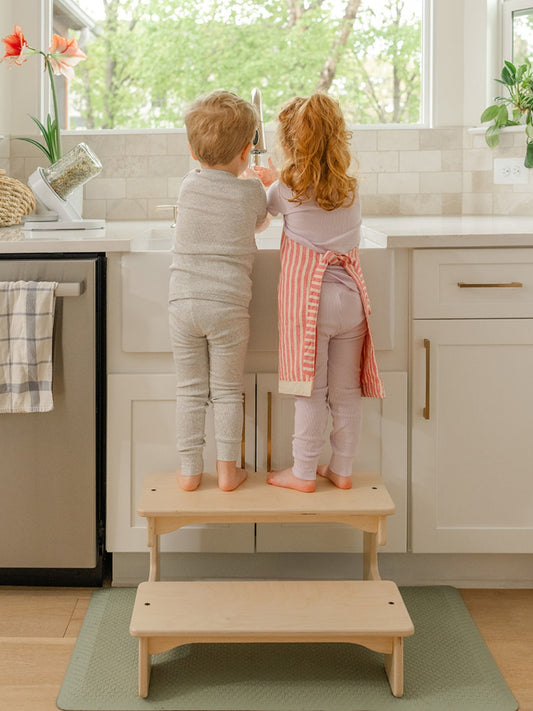
But if you have multiple kids (or twins!), a double step stool is an absolute game-changer. Blueberry and Third’s Double Stool can fit two kids side-by-side, which means:
- No more fighting over who gets to help
- Siblings can work together (cooperative play = developmental gold!)
- Morning bathroom routines become less chaotic
Both my kids use our Double Stool every single morning. My 6-year-old brushes her teeth on one side while my 4-year-old washes her hands on the other. No pushing, no "it's MY turn!"—just peaceful coexistence. (Well, most mornings. We're still working on it! 😅)
Safety Note: Why the Double Stool Works Better for Ages 3+
Here's something I learned after trying both kitchen towers (aka learning towers) and step stools for kids: as kids get older and more confident, they need different safety features.
Kitchen towers are amazing for younger toddlers (18 months - 2.5 years) because those enclosed rails prevent falls. But once kids hit 3+? Those same rails can actually create problems. I've seen kids try to climb over the rails, get their legs stuck between bars, or feel frustrated by the confinement when they just want to hop on and off quickly.
Our Double Stool eliminates these concerns:
No Entrapment Hazards - There are no rails, bars, or enclosed spaces where little arms, legs, or heads can get stuck. Kids can step on and off freely without navigating through openings or climbing over barriers.
No Tipping Hazards - The wide, stable base keeps the stool firmly planted even when two active kids are moving around on it. Unlike tall, narrow toddler towers that can tip if a child leans too far, or lightweight plastic stools that slide across the floor, our solid wood construction and low center of gravity mean it stays put.
Low to the Ground, But Just Right - At 12” tall, the Double Stool is low enough that if a child did step off unexpectedly, it's not a dangerous fall. But it's still high enough to bring them to comfortable counter height where they can work without straining or reaching overhead (which is when accidents happen).
2. The Montessori Bookshelf: Making Reading Irresistible
I'll never forget the moment my daughter, then 18 months old, walked over to our new front-facing bookshelf, pulled out "The Very Hungry Caterpillar," and plopped down to "read" it herself.
She couldn't read yet, obviously. But she could see the book covers. She could choose independently. And that changed everything.
Why traditional bookshelves don't work for toddlers: Think about it—when books are spine-out on a tall shelf, toddlers can't:
- See what books they have
- Reach them independently
- Put them back easily (hello, floor books!)
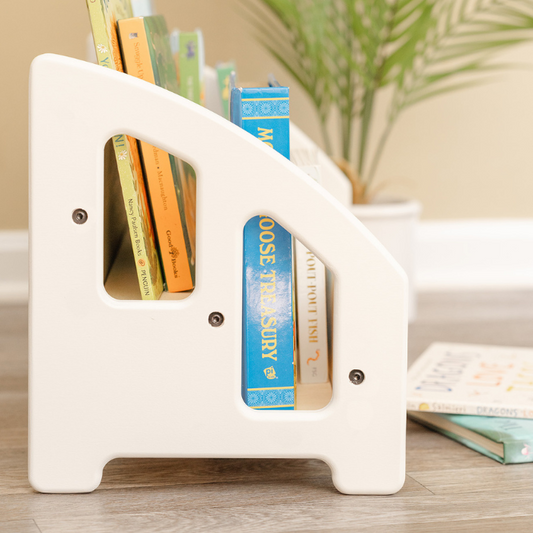
A Montessori bookshelf (also called a book display shelf) solves this by displaying books face-out at your child's eye level.
What this looks like in real life:
Before our front-facing bookshelf:
- "Mommy, I want a book!" (x1000 per day)
- Books scattered everywhere
- Reading felt like a chore I had to orchestrate
After:
- My kids choose books independently
- They actually put them back (most of the time! Still working on that too)
- Reading became their idea, not mine
What makes a good Montessori bookshelf:
- Low to the ground – Babies can reach all shelves
- Front-facing books – Display book covers visible, not spines
- Sturdy shelves – Will hold up to enthusiastic book pulls
- Room for rotation – Space for 12-20 books (not your entire library)
Blueberry and Third’s Bookshelf holds about 30-45 books depending on size, which is perfect for toy rotation (more on that later!). I swap out books every 2-3 weeks based on what my kids are interested in, seasons, or borrowed from the local Library.
Hot take: You don't need a massive library. A few good books, rotated regularly, are WAY more valuable than 100 books gathering dust.
3. The Balance Board: Active Play That Actually Has Purpose
Okay, I'll admit it: when I first saw a balance board for toddlers, I thought it was just another trendy toy.
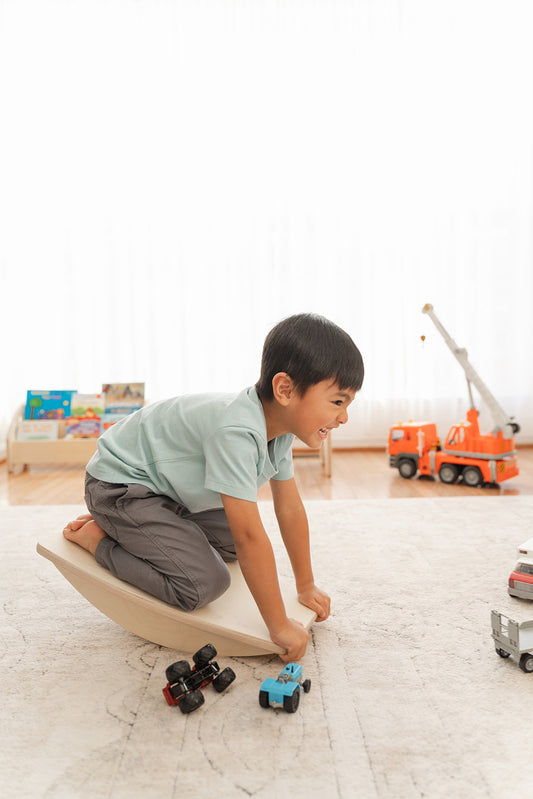
Then I watched my son (Ms. Constant Motion herself) spend 45 minutes—FORTY-FIVE MINUTES—balancing, rocking, and building with it. No screens. No begging me to play. Just focused, independent, active play.
I was sold.
What is a Montessori balance board? A wooden balance board is a curved board that kids can use for:
- Balancing and rocking (gross motor development)
- A bridge for toy cars and animals
- A slide for stuffed animals
- A reading nook when flipped over
- A seat, a stepping stone, a boat—the possibilities are endless
The beauty of open-ended play: Unlike battery-operated toys that do one thing, a kids wooden balance board is completely open-ended. My kids have used ours as:
- A bridge for cars going anywhere
- A surfer balance board
- A balance beam for "gymnastics"
- A quiet rocking chair when they need to calm down
- A table for tea parties
Why it matters for development:
- Vestibular system – Balancing and rocking develop the inner ear, crucial for coordination
- Core strength – Engagement without forced "exercise"
- Problem-solving – Figuring out how to balance, how to use it in play
- Proprioception – Body awareness in space
Age range: Most balance boards for kids ages 2-6 work beautifully, but honestly, my 6-year-old still uses ours frequently. She stands on it while reading (movement helps her focus!), and my 4-year-old uses which watching tv *gasp* yes, we watch tv in our house.
Blueberry and Third’s Balance Board for big kids and little ones has been through several years of daily play and still looks (and functions) like new. That's the beauty of investing in quality wooden play furniture—it lasts.
How to Set Up a Montessori Space at Home (Without Losing Your Mind)
Here's the secret nobody tells you: You don't need a Pinterest-perfect Montessori playroom.
I know. The Instagram photos are gorgeous. But real Montessori at home? It's messier. It's lived-in. And it's completely achievable in whatever space you have.
Start Small: The "One Room at a Time" Approach
When I started incorporating Montessori principles, I made the mistake of trying to overhaul our entire house at once. Spoiler: I got overwhelmed and gave up after two weeks.
Here's what actually works:
Week 1: The Bathroom
- Add a step stool for kids at the sink
- Lower the hand towel hook
- Put toothbrush and soap within reach
That's it. Just those three changes, and suddenly my kids could handle their entire morning routine independently.
Week 2: The Kitchen
- Double Step Stool for the counter (fits 2 kids!)
- Low drawer with kid-safe dishes
- Pitcher of water in the fridge they can reach
Now they can get their own water and set the table without me helicoptering.
Week 3: The Play Space
- Front-facing bookshelf with rotated toys
- Children's Balance board for active play
- Accessible storage bins
Boom. Montessori playroom vibes without buying all new furniture.
Choosing Montessori Furniture: What Actually Matters
After years of testing furniture (both as a mom and a founder), here's what I've learned actually matters:
1. Quality Over Quantity
You don't need 47 pieces of Montessori furniture. You need 3-5 solid pieces that will last for years.
Investment pieces worth the money:
- A quality children's step stool (used multiple times daily!)
- A front-facing bookshelf
- One piece of active play furniture (balance board, climbing arch, etc.)
These three alone can transform your home into a prepared Montessori environment.
2. Made in USA vs. Imported: Why It Matters
I'm obviously biased here (we make our furniture in Ohio!), but hear me out.
Why we choose to manufacture in the USA:
- Quality control – We can visit the workshop, see production firsthand
- Materials – We know exactly what wood and finishes are used
- Safety – US safety standards are rigorous
- Support local economy – Our furniture is made by skilled craftspeople in small batches
The imported furniture reality: Many beautiful Montessori furniture pieces are imported. Some are great! But others:
- Use unknown materials
- Arrive damaged from overseas shipping
- Have quality control issues
- Come with hidden costs (shipping, customs, delays)
When you're investing in furniture your child will use daily, knowing exactly what it's made of and who made it brings peace of mind.
Our furniture is made in a small woodshop in Ohio. Every piece is handcrafted, sanded smooth, and finished with child-safe materials. We're proud that it's American-made children's furniture!
3. **Aesthetics Matter (Yes, Really!)
Montessori purists might disagree, but I'll say it: Your furniture should look good in your home.
You're not going to stick with Montessori principles if you hate looking at the furniture. And that's okay!
Look for:
- Natural wood tones that complement your décor
- Clean, simple lines
- Finishes that hide fingerprints (trust me on this!)
Our furniture is designed to be functional AND beautiful—because you deserve a home that works for your kids without looking like a preschool classroom exploded
Montessori on a Budget: You Don't Need to Break the Bank
Let's be real: Montessori furniture can be expensive.
But here's the truth: You don't need everything at once.
Start with these budget-friendly moves:
Free/Nearly Free:
- Lower your closet rod with a tension rod ($10)
- Display books on a small shelf you already own
- Create a low mirror area with a $10 wall mirror
Worth investing in (buy once, use for years):
- A quality wooden step stool (used multiple times daily!)
- One good bookshelf
- A balance board (years of play!)
Where to splurge vs. save:
- Splurge: Furniture used daily (step stool, bed, bookshelf)
- Save: Décor, rotational toys, extras
Common Montessori Furniture Questions (From One Mom to Another)
"What age should I start with Montessori furniture?"
Short answer: As soon as they start showing interest in doing things themselves—usually around 12-18 months.
What that looks like:
- 12-18 months: Low shelf for books, climbing arch for movement
- 18-24 months: Add toddler balance board, kitchen stool for sink
- 2-3 years: Expand to bedroom furniture, wardrobe access
- 3+ years: Build on what's working, add complexity
"Is wooden furniture really better than plastic?"
For Montessori furniture? Yes.
Here's why:
- Durability – Wood lasts through multiple kids
- Stability – Heavier = less tipping
- Aesthetics – Looks better in your home
- Sensory – Natural materials are part of Montessori philosophy
- Safety – No questionable plastics or chemicals
Exception: Some plastic items are fine for temporary/outdoor use. But for furniture your child uses daily? Invest in wood.
"What if my house is too small for Montessori furniture?"
You need way less space than you think!
Minimal Montessori setup:
- One step stool (bathroom + moved to kitchen as needed)
- Small front-facing bookshelf (fits in any corner)
- Toddler Balance board (slides under bed when not in use)
That's literally 3 pieces and maybe 6 square feet of floor space total.
We live in a modest home. Not huge. Not Pinterest-perfect. But these three pieces have created independence in the space we have.
The Real Talk: What Montessori Furniture Can and Can't Do
Montessori furniture WILL:
- ✓ Make daily routines easier
- ✓ Build your child's confidence
- ✓ Reduce how often they need your help
- ✓ Create opportunities for independence
- ✓ Last for years (if you buy quality)
Montessori furniture WON'T:
- ✗ Make your child perfect or always cooperative
- ✗ Eliminate all messes and spills
- ✗ Work overnight (give it time!)
- ✗ Replace your involvement as a parent
- ✗ Look magazine-perfect 24/7
My kids still make messes. They still fight and they still need me.
But they can also:
- Get ready for school mostly independently
- Make their own snacks
- Choose and enjoy books on their own
- Play actively without screens
That's the magic. Not perfection—just more capable, confident kids.
Final Thoughts: Why This Matters
Six years into this parenting journey, here's what I know for sure:
The small things matter.
A step stool seems simple. A bookshelf seems basic. A balance board seems like "just" a toy.
But together? They create an environment where your child can be capable.
And capable kids become confident kids. And confident kids become adults who believe they can figure things out.
That's what Montessori at home is really about. Not perfect Instagram playrooms or expensive furniture collections.
It's about giving our kids the tools—literally and figuratively—to believe in themselves.
Ready to Start Your Montessori at Home Journey?
The three pieces that transformed our home:
- The Double Stool – For bathroom routines, kitchen help, and daily independence
- The Bookshelf – For fostering a love of reading and independent book choice
- The Balance Board – For active play that builds bodies and imaginations
Each piece is handcrafted in Ohio with the same care I'd want for my own kids' furniture (because, well, I did design it for my own kids!).
Every piece:
- ✓ Made in the USA in our small Ohio workshop
- ✓ Built from quality wood with child-safe finishes
- ✓ Designed to last through multiple children
- ✓ Thoughtfully crafted by skilled artisans
- ✓ Ships quickly (1-2 business days for in-stock items)
Join Our Community
Want more Montessori at home ideas, tips, and real-life parenting stories?
📧 Join our email community for:
- Behind-the-scenes of our small business journey
- Exclusive early access to new products and discounts
- Real talk from a mom in the trenches
Questions about which furniture is right for your family?
Email me at hello@blueberryandthird.com – I personally read and respond to every message. Because this isn't just a business to me. It's my passion as a mom who believes every child deserves furniture that helps them grow.
Here's to raising capable, confident kids—one step stool at a time. 💙
- Nikki Founder, Blueberry and Third Mom to a 6-year-old who still uses her balance board daily and a 4-year-old who insists on washing her own hands
Frequently Asked Questions
What is the best age to start using Montessori furniture? Most children can start using Montessori furniture like low bookshelves around 12-18 months, when they begin showing interest in doing things independently. Balance boards are great for ages 2-6, though many kids continue using them well beyond that!
Is Montessori furniture safe for toddlers? Yes! Quality Montessori furniture is specifically designed with toddler safety in mind. Look for sturdy wooden construction, non-slip features, rounded edges, and child-safe finishes. Our furniture is handcrafted in Ohio with all these safety features built in.
How do I set up a Montessori playroom? Start simple: a low bookshelf for book display, accessible toy storage, and an active play piece like a balance board. The key is keeping things at your child's height and rotating toys every 2-3 weeks to prevent overwhelm. You don't need a huge space—just thoughtful organization.
What's the difference between regular furniture and Montessori furniture? Montessori furniture is specifically designed to be accessible to children at their height and developmental stage. Regular furniture is sized for adults. The key difference is independence—Montessori furniture allows children to do things themselves without adult help.
Where can I buy quality Montessori furniture made in the USA? We handcraft all our Montessori furniture in a small Ohio workshop. Each piece—from our Double Stool to our Balance Board—is made with quality wood and child-safe finishes. Shop our collection here.